
Understand your repair estimate.
A repair quote is fair when every line is itemized, the parts sit near the going price, and the labor follows standard book time. Most estimates pass that test. Here is how to read yours, line by line, so you can approve the work with confidence.
Decode it
What every line on your estimate means
Every estimate is built from the same handful of line items. Once you know what each one means, the whole quote makes sense.
Parts
The physical components: pads, a starter, a water pump. Shops buy parts at a wholesale price and mark them up to cover sourcing and warranty, which is normal and expected. Knowing the part number and brand just helps you understand exactly what you are getting.
Labor
The part most drivers do not know: labor is billed as book time, a standardized flat-rate estimate for the job, times the shop's hourly rate. It is not the actual minutes spent, so an experienced tech who works quickly still bills the standard time.
Shop supplies and fees
A catch-all line for rags, cleaners, and small hardware, usually a small percentage of labor. It is a normal part of running a shop. If you are ever curious what it covers, any shop can walk you through it.
Diagnostic fee
The charge to find out what is wrong, usually about an hour of labor. It pays for real expertise and equipment. A good thing to ask up front: many shops credit it back toward the repair if you have the work done there.
Taxes
Sales tax applies to parts in most states, and sometimes to labor too. It should read as a clear percentage of the subtotal. Nothing surprising here, it is just good to see how the total adds up.
Disposal fee
A few dollars to legally recycle old oil, coolant, brake fluid, tires, or a battery. It shows up on jobs that create waste and is required in most states. Small, expected, and good to see itemized.
The green flags
What a clear, professional estimate looks like
The best shops make their work easy to understand. Here is what a great estimate has in common, so you know good work when you see it.
Every line is itemized
Parts and labor are broken out separately for each repair, with quantities and prices you can actually read.
It explains why each item is needed
A good estimate connects each repair to a symptom or a measurement, so you understand the reason for every line.
The shop will show you the part
Ask to see the leaking hose or the worn brake pad and a good shop walks you out to the car. Seeing it makes the repair make sense.
It uses standard book time
Labor hours follow the published flat-rate guide for the job, the same standard every shop works from.
It helps you prioritize
A good shop tells you what is safety-critical today and what can reasonably wait, so you can plan the work around your budget.
It welcomes your questions
A shop that is confident in its work is happy to explain the estimate. That openness is one of the best signs you are in good hands.
Cost guide
What common repairs typically cost
Ballpark ranges for a typical passenger vehicle, parts and labor combined, so you know what to expect. Your exact price depends on the car, your region, and OEM versus aftermarket parts.
Brake pads (per axle)
$195 to $460
Alternator
$520 to $1,150
Starter
$460 to $980
Timing belt
$650 to $1,300
Catalytic converter
$1,150 to $3,250
Radiator
$520 to $1,150
AC compressor
$910 to $1,700
Water pump
$520 to $1,150
Oil change
$50 to $155
These are ballpark ranges, not fixed prices. A luxury or European model can run well above the top of the range.
Parts
OEM or aftermarket parts?
Your estimate's parts line is one or the other, and both are legitimate choices. Here is the tradeoff, so you can decide what fits your car and budget.
| OEM | Quality aftermarket | |
|---|---|---|
| What it is | Made by or for the automaker, the exact factory part. | Made by a third party to fit your car, often to the same spec. |
| Typical price | Higher | Roughly 20 to 50% less |
| Warranty | Usually longer, dealer-backed | Varies by brand, often 1 to 2 years |
| Best when | Newer or leased cars, complex electronics, warranty work | Out-of-warranty repairs where value matters |
Ask away
Good questions to ask your shop
You do not need to be an expert. A few simple questions help you understand the work and make a confident decision, and good shops are glad to answer them.
Ask for an itemized written estimate
Get it on paper or by text, with parts and labor split out for each repair. It makes the whole job easy to understand, and most shops provide it as a matter of course.
Ask what is safety-critical versus what can wait
Not everything is urgent. Ask the shop to sort the list into fix-now and can-wait, so you can plan the work around your budget.
Ask whether parts are OEM or aftermarket
OEM parts come from the carmaker and cost more. Quality aftermarket parts often do the same job for less. Ask about both so you can choose what is worth it for your car.
Ask about the warranty
Find out how long the parts and labor are covered. A solid warranty is a sign of a shop that stands behind its work, and it is good to know before you say yes.
Ask to see the part
The simplest question of all is "can you show me?" A worn pad or a leaking gasket is easy to point to, and seeing it makes the whole repair click.
Ask what happens if they find more
Sometimes a shop opens things up and finds extra work. Ask whether the estimate is firm or could change, and for a quick call before anything beyond what you already approved.
For the big ones
When a second estimate makes sense
For a major repair, getting a second estimate is completely normal, and a confident shop has no problem with it. On a big job it is one of the smartest hours you can spend, and it gives you peace of mind either way.
For a small, clearly explained repair, one good shop is plenty. Save the second look for the repairs that are a real financial decision.
A second look is worth it for:
- Major work like engine or transmission repair
- Any repair that is a real financial decision (roughly $500 and up)
- A complex diagnosis you want to understand fully
- A repair you simply want a second perspective on
Not sure? Get a clear read in a minute.
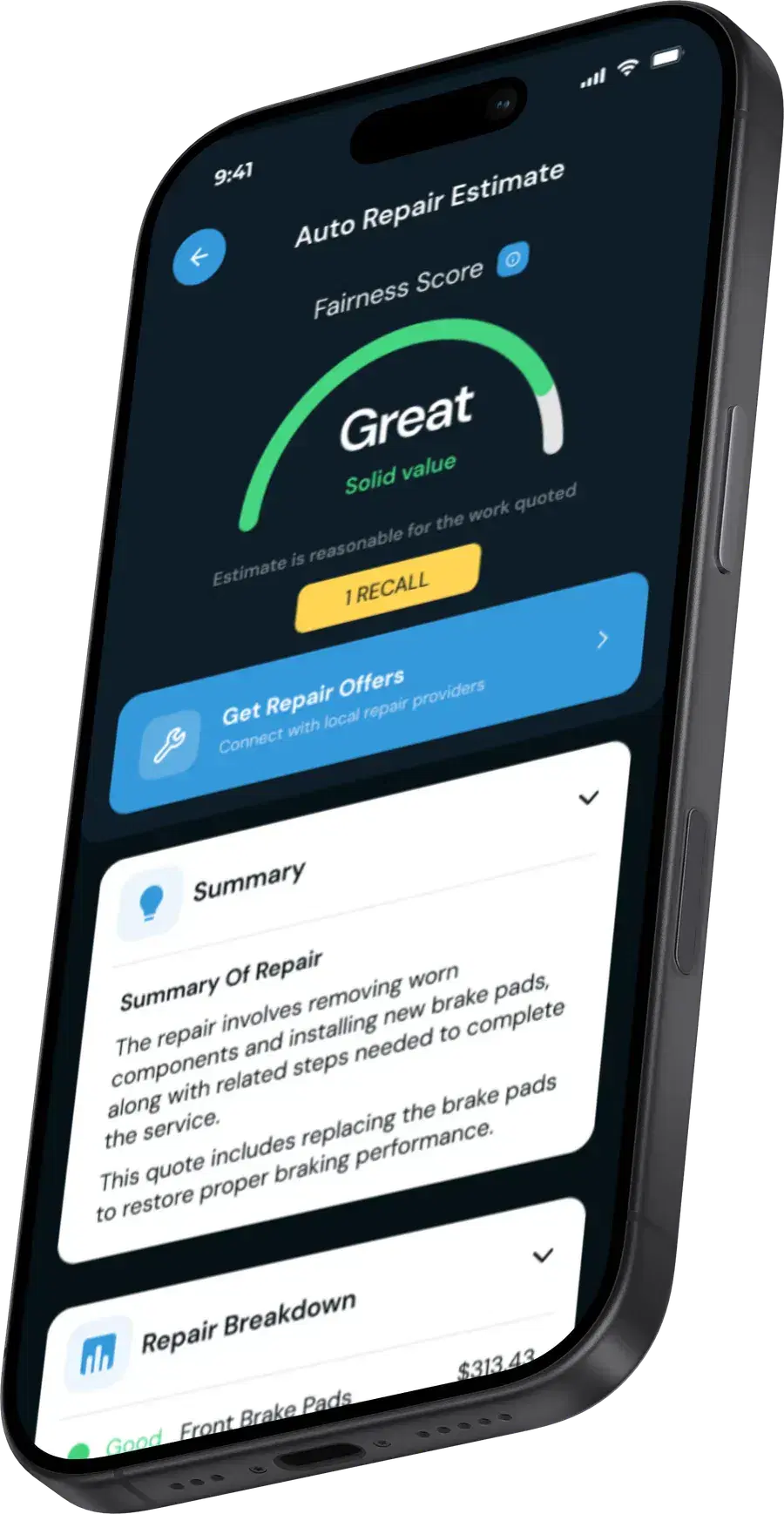
Snap a photo of your estimate and Fixxr breaks it down line by line, gives you a plain-English read on the pricing, and shows you what the repair typically costs near you. Free, in about a minute.
Estimate FAQ
Questions drivers actually ask
How do I know if my repair estimate is fair?
Start with an itemized estimate and understand each line. Parts should sit near the going price, and labor should follow the standard book time for the job. If you want a quick gut check on the total, compare it against a typical range for that repair, or scan the estimate with Fixxr for a plain-English read. Most estimates are fair, and understanding yours is how you approve the work with confidence.Is it okay to ask questions about an estimate?
Absolutely. A good shop expects questions and answers them without missing a beat. It is your car and your money, and asking what a line item is for is completely reasonable. Most shop owners would rather you understand the work than nod along, because an informed customer is an easy one to work with.Should I always get a second estimate?
Not for a routine oil change or a small, clearly explained repair. Do consider one for major work like engine or transmission repair, or any repair that is a real financial decision. On a big job a second estimate costs you an hour and gives you peace of mind, and a confident shop has no problem with it.Can I bring my own parts to a shop?
Sometimes. Some independent shops allow it, but many prefer to supply the parts so they can warranty them, and they still charge for labor either way. If a shop does install your parts, expect no warranty on those specific components. For most drivers it is simpler to ask the shop about a quality aftermarket option, which usually closes most of the price gap.What is a typical labor rate?
It varies by region and shop type. Independent shops commonly land somewhere around $90 to $150 an hour, and dealerships often run higher. The rate matters less than the hours: labor is billed as standardized book time, not actual minutes, so it helps to know how many hours the job is booked at.
You deserve a fair fix.
Tell us what is wrong. A verified mechanic comes to you.