
What is that dashboard light?
Decode any warning symbol or check-engine code. See how urgent it is, what usually causes it, and what a fair repair should cost.
Works for any OBD-II trouble code on cars built since 1996.
Read the code
What the letters and numbers mean
Every OBD-II code has the same shape: a letter for the system, then four digits. Take P0300:
System
Powertrain (engine and transmission). B is Body, C is Chassis, U is Network.
Standard
Generic and standardized across all makes. A 1 here means a manufacturer-specific code.
Subsystem
The area of the fault, here the ignition system and misfires.
Specific fault
The exact problem, here a random or multiple-cylinder misfire.
First 60 seconds
The light just came on. What now?
Before you book anything, four quick checks tell you whether this is a pull-over problem or a this-week problem.
Check the color first
Red means stop as soon as it is safe. Amber or yellow means the car logged a fault and wants service, but it is usually not an emergency.
Is it flashing?
A flashing check-engine light is the one exception to amber being calm. It signals an active misfire that can damage the catalytic converter. Ease off the throttle and get help.
Scan the gauges
Glance at temperature and oil pressure. If the needle is in the red or the oil light is on, pull over and shut the engine off rather than pushing on.
Pull the code
A basic OBD-II reader, or a free scan at most parts stores, gives you the code. That single string turns a mystery light into a specific starting point.
Know your lights
Common dashboard warning lights
Red means stop and address it now. Amber means service soon. Gray is one to keep an eye on.
Code library
Popular check-engine codes
The trouble codes drivers look up most. Each one opens a full breakdown of what it means, what causes it, and what the fix costs.
Random or Multiple Cylinder Misfire
$195 to $1,550
Cylinder 1 Misfire Detected
$195 to $1,150
System Too Lean (Bank 1)
$130 to $910
Catalyst System Efficiency Below Threshold (Bank 1)
$330 to $3,250
Coolant Thermostat Below Regulating Temperature
$195 to $650
Evaporative Emission System Leak Detected (Large Leak)
$0 to $520
Evaporative Emission System Leak Detected (Small Leak)
$25 to $780
Transmission Control System Malfunction
$195 to $4,550
Intake Air Temperature Sensor Circuit High Input
$100 to $460
O2 Sensor Heater Circuit Malfunction (Bank 1, Sensor 1)
$195 to $650
Catalyst System Efficiency Below Threshold (Bank 2)
$330 to $3,250
Evaporative Emission Control System Vent Control Circuit
$130 to $590
"A" Camshaft Position Timing Over-Advanced (Bank 1)
$130 to $910
Mass Air Flow (MAF) Circuit Range/Performance
$40 to $520
Crankshaft Position to Camshaft Position Correlation (Bank 1 Sensor A)
$260 to $3,250
Knock Sensor 1 Circuit (Bank 1)
$260 to $780
Exhaust Gas Recirculation (EGR) Flow Insufficient
$130 to $850
Camshaft Position Sensor Circuit (Bank 1)
$130 to $590
Cylinder 2 Misfire Detected
$195 to $1,150
Cylinder 3 Misfire Detected
$195 to $1,150
Cylinder 4 Misfire Detected
$195 to $1,150
System Too Rich (Bank 1)
$130 to $780
System Too Lean (Bank 2)
$130 to $910
Throttle Position Sensor Range/Performance
$130 to $650
O2 Sensor Circuit Low Voltage (Bank 1, Sensor 1)
$195 to $590
O2 Sensor Heater Circuit Malfunction (Bank 1, Sensor 2)
$195 to $590
Turbocharger/Supercharger Underboost
$260 to $2,600
Crankshaft Position Sensor Circuit
$195 to $650
Evaporative Emission Control System Malfunction
$0 to $780
Evaporative Emission System Leak Detected (Very Small Leak)
$25 to $780
Idle Air Control System RPM Higher Than Expected
$100 to $520
System Voltage Low
$195 to $910
Torque Converter Clutch Circuit Performance or Stuck Off
$195 to $2,600
"B" Camshaft Position Timing Over-Retarded (Bank 1)
$130 to $910
Good to know
How urgent is your warning light?
Solid amber
The system logged a fault but it is not an emergency. Get it scanned soon. Driving gently until then is usually fine.
Flashing amber
An active misfire is dumping raw fuel into the exhaust and can wreck your catalytic converter. Ease off and get help right away.
Red light
Oil pressure, temperature, brakes, or charging. These mean stop as soon as it is safe. Continuing can cause severe damage.
In the app
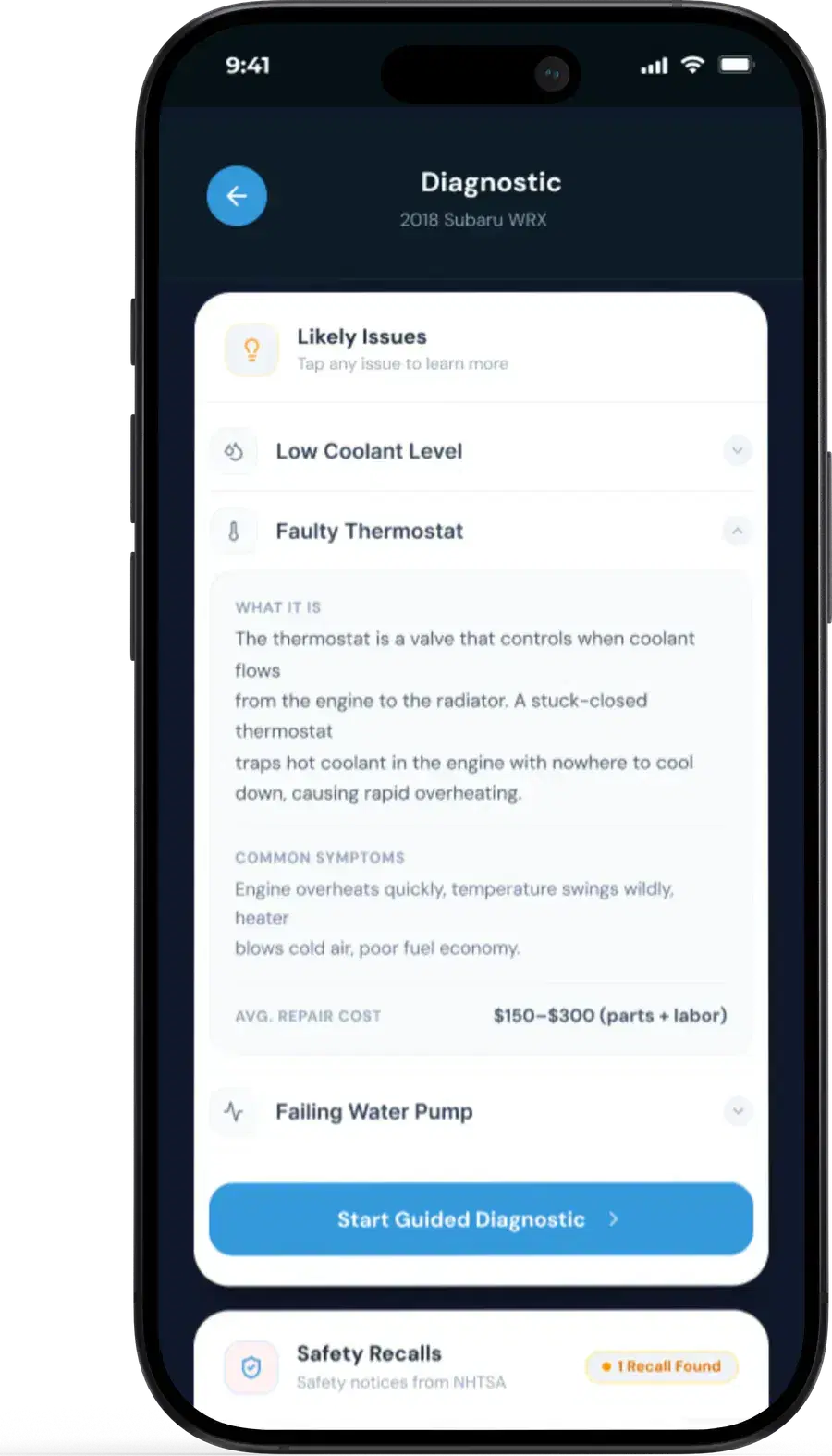
Not sure what is wrong? Let Fixxr help.
Describe the problem or record a short video, and Fixxr walks you through the likely issues, what each one means, and what a fair repair should cost, so you walk in informed.
Got an estimate for the repair already?
See how to read it line by line and what the fix typically costs, so you can approve the work with confidence.
Warning-light FAQ
Check-engine questions
Is it safe to drive with the check-engine light on?
A steady check-engine light usually means you can drive carefully to a shop soon. A flashing light means a serious misfire that can wreck your catalytic converter, so pull over and get it checked right away. Red lights for oil, temperature, or brakes generally mean stop as soon as it is safe.Why is my check-engine light flashing?
A flashing light almost always signals an active engine misfire. Raw fuel is reaching the exhaust and can quickly destroy the catalytic converter, which is an expensive repair. Reduce speed, avoid hard acceleration, and get it diagnosed immediately.Can I read the code myself?
Yes. A basic OBD-II scanner, or a free reading at many auto-parts stores, will pull the trouble code from any car built since 1996. The code points you to the system at fault, though confirming the exact cause still takes real diagnosis.Can I just clear the code and ignore it?
Clearing a code turns the light off, but if the underlying problem is still there it will come back, and you will have erased data that helps diagnose it. Fix the cause rather than resetting the symptom.The light went off by itself. Do I still need a repair?
Sometimes a fault clears on its own, such as a loose gas cap that got tightened. But an intermittent light often means an intermittent fault that will return. It is worth scanning for stored codes even after the light goes out.Does a code tell me exactly which part to replace?
Not quite, and this is worth understanding. A code names the circuit or system reporting a problem, not the exact broken part. P0420, for example, points at catalyst efficiency, which can be a failing converter or simply a tired oxygen sensor. A proper diagnosis confirms the real cause, so the right repair happens the first time.
You deserve a fair fix.
Tell us what is wrong. A verified mechanic comes to you.