
Home/Repair costs/2018 Honda CR-V/Torque converter replacement
2018 Honda CR-V · Torque converter replacement
2018 Honda CR-V torque converter replacement cost
A 2018 Honda CR-V torque converter replacement typically costs $1,165 to $2,095 at an independent shop, parts and labor included across its engine options. The torque converter itself runs $320 to $560, and the job takes 6 to 9 hours. Prices updated October 2026.
Estimated cost, selected engine
$1,165 to $2,005
Charlotte, NC area
Prices updated October 2026
Which engine? They price differently, so pick yours for a closer number.
Torque converter (part)
$320 to $560
Labor (6 to 9 hours)
$715 to $1,350
Fluids + supplies
$130 to $185

2018 Honda CR-V torque converter replacement: parts and labor
Labor runs $715 to $1,350 (the job takes 6 to 9 hours at typical independent-shop rates), and the torque converter itself typically costs $320 to $560 for the 2018 Honda CR-V, plus $130 to $185 in cvt fluid (genuine honda hcf-2, ~7 qt refill) + shop. Prices updated October 2026.
| Engine | Parts | Labor | Estimated total |
|---|---|---|---|
| 2.4L I4 (LX, FWD/AWD) | $320 to $470 | $715 to $1,350 (6.5 to 9.0 hrs) | $1,165 to $2,005 |
| 1.5L Turbo I4 (EX-Touring) | $380 to $560 | $715 to $1,350 (6.5 to 9.0 hrs) | $1,225 to $2,095 |
Coverage note: Does not cover the CR-V Hybrid, which Honda did not offer until MY2020, or export/JDM CVT calibrations; the 2.4L and 1.5L turbo above are the only two factory US-market powertrains for MY2018.
Genuine Honda dealer parts run about $786 (2.4L, part 26000-5LJ-325) to $939 (1.5T, part 26000-5RG-305) for the converter alone before labor, roughly double to triple a quality aftermarket or OEM take-off unit, and dealer shop labor rates typically run above the $110-150/hr independent range used here.
Where these numbers come from
- Estimate ranges: a hand-verified research pass for this exact vehicle and repair, cross-referenced across 12 independent sources (parts retailers, labor guides, and published shop pricing), completed September 2026.
- Recall and complaint data: NHTSA (National Highway Traffic Safety Administration) records for the 2018 Honda CR-V specifically, filtered to transmission relevance and refreshed daily from the federal API.
- Local prices: real, accepted quotes from verified Fixxr marketplace jobs, published per metro once five verified jobs of this type have closed. Never estimates dressed up as transactions.
Not included in the estimate: Diagnostic teardown and the TSB 17-050 fluid-and-TCM recalibration check needed to rule out a fluid-only fix before condemning the converter, CVT drive belt, pulley set, valve body, or a full CVT reman/replacement if wear extends beyond the torque converter, Refundable core charge and core return shipping charged by most reman or take-off suppliers, AWD propeller shaft reseal, engine/transmission mounts, or subframe hardware replaced incidentally during the cradle drop, Sales tax, shop supply fees beyond the listed consumables, and towing.
What actually goes wrong on this exact vehicle
Federal safety data for the 2018 Honda CR-V, filtered to the transmission specifically.
0
transmission recalls
16
transmission owner complaints
Real owner report, verbatim from NHTSA:
“The transmission had a MAJOR failure after a routine trans fluid drain and fill done by Phillipsburg Easton Honda. They tried blaming me and dismissing it as an already compromised transmission. But breaking down on a very busy road and losing all control over a LOCKED up car was terrifying and dangerous. Im just glad nobody was injured. Honda has taken 0 accountability for it and claims they did nothing wrong. This car is only 8 years old. Honda brags about them lasting forever. The CVT transmissions are garbage and now im stuck paying 7k for a replacement. No goodwill offered- no warranty. These are known to be problematic.”
Get the failure confirmed with a real diagnosis before you approve the repair, so you fix the part that actually failed.
Recall fixes are free at the dealer. Everything else deserves a fair price.
Source: NHTSA (National Highway Traffic Safety Administration), recalls and complaints for the 2018 Honda CR-V. Refreshed periodically.
Not sure what’s wrong?
A shudder or slip can be the torque converter, the transmission itself, worn mounts, or even misfires. Describe what your truck is doing and our free diagnostic tool narrows it down before you spend a dollar.
Diagnose it freeKnow what you need?
Post your torque converter replacement to the marketplace and get connected with local mechanics. Real repair offers for your CR-V, free, with no phone calls to make.
Get connected with a mechanicHow your torque converter works
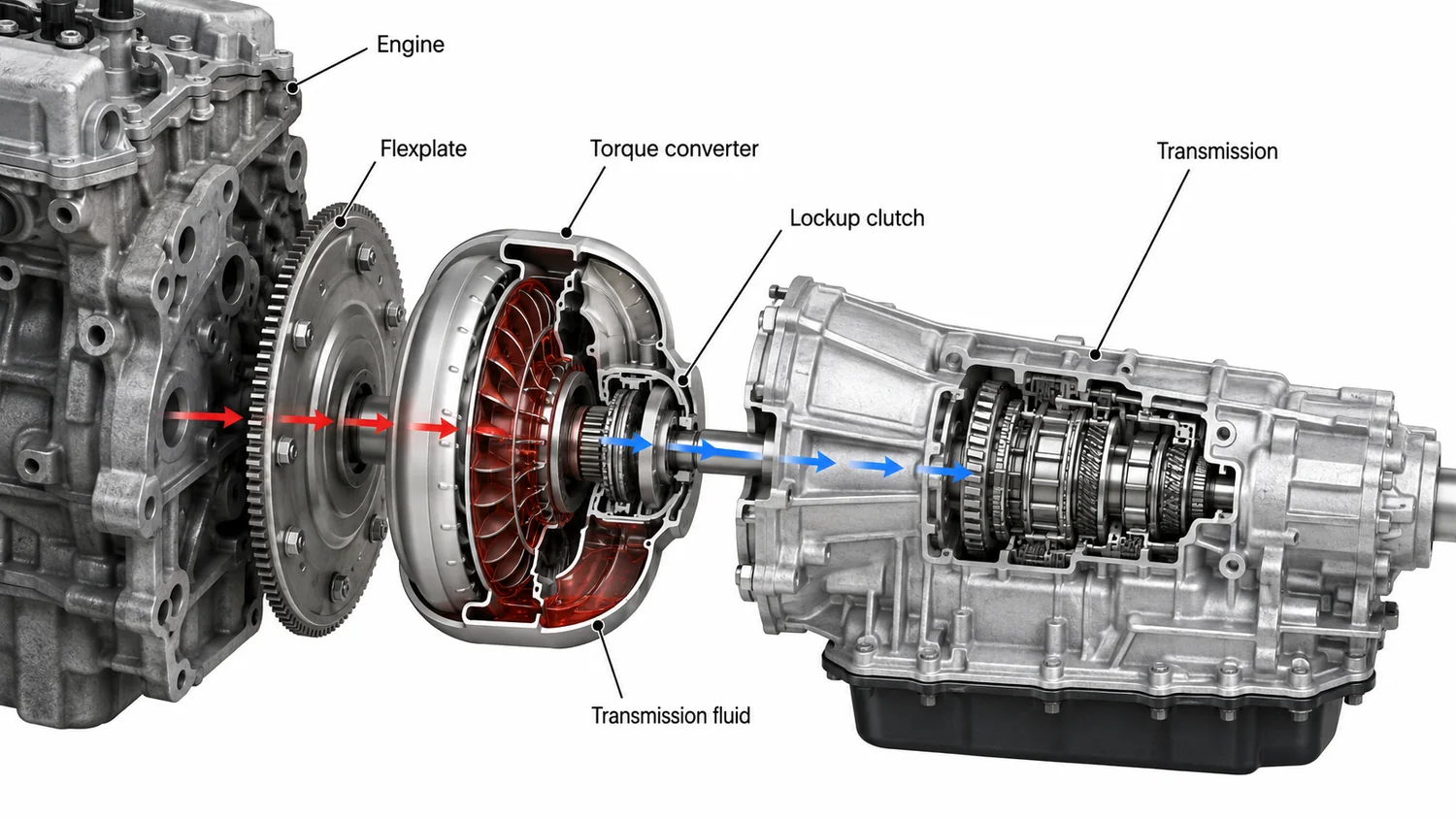
The torque converter is the fluid coupling between the engine and the automatic transmission in your 2018 Honda CR-V. It lets the engine keep spinning at a stoplight, multiplies torque when you pull away, and at cruising speed an internal lockup clutch grips solid to stop wasting fuel. That clutch is the part that wears out, and because the converter bolts on between the engine and transmission, replacing it means removing the transmission, which is why labor is most of the bill.
Four signs it’s the torque converter
Shudder at steady speed
A rumble-strip vibration at light throttle on the highway. The classic sign of a worn converter lockup clutch.
RPM flares, truck doesn't
Engine revs climb without matching speed. The converter or transmission is slipping instead of gripping.
Delayed or harsh engagement
A pause or clunk when shifting into drive or reverse, especially cold.
Hot, dark, or burnt fluid
A slipping converter cooks the fluid. Dark color or a burnt smell means friction material is circulating.
The free check: on a quiet road, hold a steady 45 to 55 mph at light throttle. A vibration that appears in that zone and fades when you accelerate or lift off points at the converter clutch. Mention exactly when it happens to your shop; it is the single most useful thing you can tell them.
What a torque converter replacement is like on the 2018 Honda CR-V
Both 2018 CR-V powertrains, the LX-only 2.4L and the EX/EX-L/Touring 1.5L turbo, route power through Honda's transverse KA-family CVT, and unlike a step-gear automatic where a pan drop sometimes gets you partway to the converter, this transaxle's bellhousing sits tight against the firewall and front subframe. A proper R&R means unbolting the front subframe cradle and lowering the engine/transmission as a unit roughly 8 to 10 inches to pull the transaxle rearward off the flexplate and access the converter behind it. That is why the job runs 6.5 to 9.0 hours of shop time even though the converter swap itself takes under 30 minutes once the transmission is out. AWD cars add another 30 to 60 minutes for the rear propeller shaft disconnect and extra wiring, which is already folded into the top of the labor range rather than broken out separately.
Real-world CVT shudder complaints on the 2015-2018 CR-V cluster between roughly 30,000 and 80,000 miles and show up as a rumble-strip-like judder in the 15-40 mph range or during steady highway cruise. NHTSA opened Preliminary Evaluation PE17023 on the complaint volume, and Honda's own dealer bulletins point to heat-degraded CVT fluid attacking the torque converter lock-up clutch material as the common root cause, not a worn-out part on its own. That is why the first-line dealer fix under TSB 17-050 is a full genuine HCF-2 drain-and-refill plus a TCM software recalibration, with a follow-up highway-shudder calibration under TSB 19-070 and a P2817 software fix under TSB 19-047. A torque converter swap is properly the last step after the fluid and software fix fails to clear the shudder, not the first thing to throw parts at.
Genuine Honda actually lists two different torque converter part numbers for MY2018 CR-V even though both engines share the same KA CVT case family: 26000-5LJ-325 for the LX-only 2.4L (dealer list around $786) and 26000-5RG-305 for EX/EX-L/Touring 1.5T cars (dealer list around $939). The internal damper and lock-up clutch calibration differs to match each engine's torque delivery. The 1.5T holds peak torque essentially flat from about 1,800 rpm to 5,000 rpm, a much broader plateau than the naturally aspirated 2.4L, which is why the two converters are not cross-compatible despite sharing a transmission family name.
Owners searching '2018 CR-V transmission problems' frequently conflate two unrelated issues. The CVT judder above is one; the far more publicized 1.5T 'oil dilution' complaint (unburned fuel washing into the crankcase during cold starts, raising the oil level and thinning it) is a completely separate engine lubrication issue tied to the camshaft and rocker arm assemblies. It triggered a real April 2019 American Honda warranty extension (TSBs 19-032/19-033 and 19-037/19-038) stretching powertrain coverage on those parts from 5 years/60,000 miles to 6 years/unlimited miles. The oil-dilution fix does touch CVT control software as one of several calibration tweaks to warm the engine faster, but it is not a transmission defect and will not cause torque converter failure. Also worth knowing, there is no NHTSA safety recall on the CR-V's CVT or its torque converter. Every item above (17-050, 19-070, 19-047) is a technical service bulletin or goodwill warranty program, not a mandated recall, so a used 2018 CR-V outside Honda's 5 year/60,000 mile powertrain warranty is entirely an out of pocket repair.
Because this converter is a fairly low-volume specialty part next to a common step-gear automatic core, mainstream chain parts stores (AutoZone, Advance, RockAuto) largely do not stock a confirmed-fit standalone unit for the 2015-and-later CVT CR-V; the SKUs that surface under a generic 'Honda CR-V' search mostly cross-reference the earlier 2007-2014 5-speed-automatic generation instead. Real supply for this specific part runs through Honda-parts specialty resellers and the used/OEM-take-off channel, where fitment-confirmed 2017-2020 take-offs trade for roughly $300 to $330 on eBay, or through specialty rebuilders who bundle a rebuilt converter into a complete reman CVT assembly alongside the belt and valve body. That bundling is also why several independent transmission shops quote this job as a torque converter and clutch pack rebuild near $1,500 rather than a bare parts swap.
Estimate note: these are researched independent-shop ranges, not a guaranteed quote. The only exact number is one from a shop that has seen your car.
Frequently asked questions
How much does a 2018 Honda CR-V torque converter replacement cost?
A 2018 Honda CR-V torque converter replacement typically runs $1,165 to $2,095 at an independent shop, parts and labor included. The torque converter itself is $320 to $560, labor makes up most of the rest, and the job takes 6 to 9 hours.Why does the price change with the engine?
The 2018 Honda CR-V came with more than one engine, and they do not share the same part or the same access. A tighter engine bay or extra teardown adds labor hours, and the part price moves too. Sites that show one national number flatten that out. Pick your engine on the estimate above for a closer figure.What are the signs of a bad torque converter?
The classic sign is a shudder at steady highway speed under light throttle, a rumble-strip vibration that comes and goes as the converter's lockup clutch grabs and slips. Others: engine RPM flaring up without the truck speeding up, a delayed or harsh clunk into drive, a whine that changes with gear, and transmission temperature climbing on grades. These symptoms overlap with internal transmission problems and even engine misfires, so get a real diagnosis before paying for either.Can I drive my Honda with a bad torque converter?
Briefly, but it gets more expensive the longer you wait. A slipping converter sheds clutch material into the transmission fluid and runs hot, and that debris circulates through the entire transmission. Caught early, this can be a converter and fluid job. Ignored, it becomes a full rebuild at several times the price. If it shudders occasionally, book the repair soon; if it slips hard or overheats, stop driving it.Should the transmission be rebuilt at the same time?
Fluid condition is the tell. If the fluid is clean and the failure is isolated to the converter clutch, a converter-only replacement is a legitimate fix, and the labor is already paid since the transmission comes out either way. If the fluid is dark, smells burnt, or carries metal or friction material, converter debris has been through the whole unit and a reputable shop will recommend a rebuild instead of bolting a new converter to a dying transmission. Ask to see the fluid and the pan.How long does a torque converter last?
Usually the life of the transmission, commonly 100,000 to 200,000 miles. The weak point is the lockup clutch inside the converter, which wears like any friction clutch, and worn-out fluid accelerates it. Regular transmission fluid service is the cheapest way to extend converter life, and it is also what keeps a future repair converter-only instead of a rebuild.
More 2018 Honda CR-V repair costs
Related transmission repairs
You deserve a fair fix.
Tell us what is wrong. A verified mechanic comes to you.