
Home/Repair costs/2018 Hyundai Elantra/Alternator replacement
2018 Hyundai Elantra · Alternator replacement
2018 Hyundai Elantra alternator replacement cost
A 2018 Hyundai Elantra alternator replacement typically costs $315 to $770 at an independent shop, parts and labor included across its engine options. The alternator itself runs $190 to $460, and the job takes 1 to 3 hours. Prices updated October 2026.
Estimated cost, selected engine
$315 to $715
Charlotte, NC area
Prices updated October 2026
Which engine? They price differently, so pick yours for a closer number.
Alternator (part)
$190 to $460
Labor (1 to 3 hours)
$110 to $270
Fluids + supplies
$15 to $40

2018 Hyundai Elantra alternator replacement: parts and labor
Labor runs $110 to $270 (the job takes 1 to 3 hours at typical independent-shop rates), and the alternator itself typically costs $190 to $460 for the 2018 Hyundai Elantra, plus $15 to $40 in shop supplies, terminal cleaning, belt inspection. Prices updated October 2026.
| Engine | Parts | Labor | Estimated total |
|---|---|---|---|
| 2.0L I4 | $190 to $450 | $110 to $225 (1.0 to 1.5 hrs) | $315 to $715 |
| 1.4L Turbo (Eco) | $225 to $460 | $132 to $270 (1.2 to 1.8 hrs) | $372 to $770 |
| 1.6L Turbo (Sport) | $200 to $450 | $132 to $270 (1.2 to 1.8 hrs) | $347 to $760 |
Coverage note: No trims are excluded: the 2018 US Elantra sedan offered no hybrid or EV, so all three factory powertrains (2.0L, 1.4T Eco, 1.6T Sport) are in the table; the Elantra GT hatchback is a separate chassis (i30-based) with its own parts catalog and is not covered here.
A dealer installing the genuine Mando unit prices the part off its $719 to $799 MSRP and bills labor at $160 to $190 per hour, putting typical dealer totals around $950 to $1,200 for the 2.0L. That premium buys the Hyundai-boxed version of the same Mando alternator the independent range above already includes at roughly half the parts cost.
Where these numbers come from
- Estimate ranges: a hand-verified research pass for this exact vehicle and repair, cross-referenced across 12 independent sources (parts retailers, labor guides, and published shop pricing), completed September 2026.
- Recall and complaint data: NHTSA (National Highway Traffic Safety Administration) records for the 2018 Hyundai Elantra specifically, filtered to charging system relevance and refreshed daily from the federal API.
- Local prices: real, accepted quotes from verified Fixxr marketplace jobs, published per metro once five verified jobs of this type have closed. Never estimates dressed up as transactions.
Not included in the estimate: Charging-system diagnosis time (typically 0.5 to 1.0 hour billed separately), Serpentine belt and tensioner, commonly replaced at the same time ($25 to $80 in parts), Battery replacement or recharge if the battery was run flat by the failing alternator, Sales tax, shop supply fees, and refundable core charges ($30 to $78 on reman units), Towing if the car died on the road.
What actually goes wrong on this exact vehicle
Federal safety data for the 2018 Hyundai Elantra, filtered to the charging system specifically.
0
charging system recalls
2
charging system owner complaints
Real owner report, verbatim from NHTSA:
“In regards to my 2018 Hyundai Elantra Limited currently with 47000 miles, driving and noticed the a/c temp display which also controls fan speed stopped working, display was blank. Checked all other electrical equipment inside car with no problem except that the heated seat function didn't work also.while doing an exterior inspection noticed that all lights except the headlights worked.After the interior and exterior inspection and no error codes or indicators on the dash, I had the alternator, battery and starter checked along with probe testing every fuse in the car and under the hood checked and everything was fine. The Car has been perfect up to this point which is alarming because if the headlights go out while driving at night or in the rain this is a safety problem and driving citation. My only indication of when this happens is if the a/c control display goes out. The problem is intermittent and Hopefully it won't happen again and I couldn't find any other similar things like this happening to others.”
Get the failure confirmed with a real diagnosis before you approve the repair, so you fix the part that actually failed.
Recall fixes are free at the dealer. Everything else deserves a fair price.
Source: NHTSA (National Highway Traffic Safety Administration), recalls and complaints for the 2018 Hyundai Elantra. Refreshed periodically.
Not sure what’s wrong?
A battery light or a car that dies while driving can be the alternator, the battery, or the wiring. Describe what your car is doing and our free diagnostic tool narrows it down before you spend a dollar.
Diagnose it freeKnow what you need?
Post your alternator replacement to the marketplace and get connected with local mechanics. Real repair offers for your Elantra, free, with no phone calls to make.
Get connected with a mechanicHow your charging system works
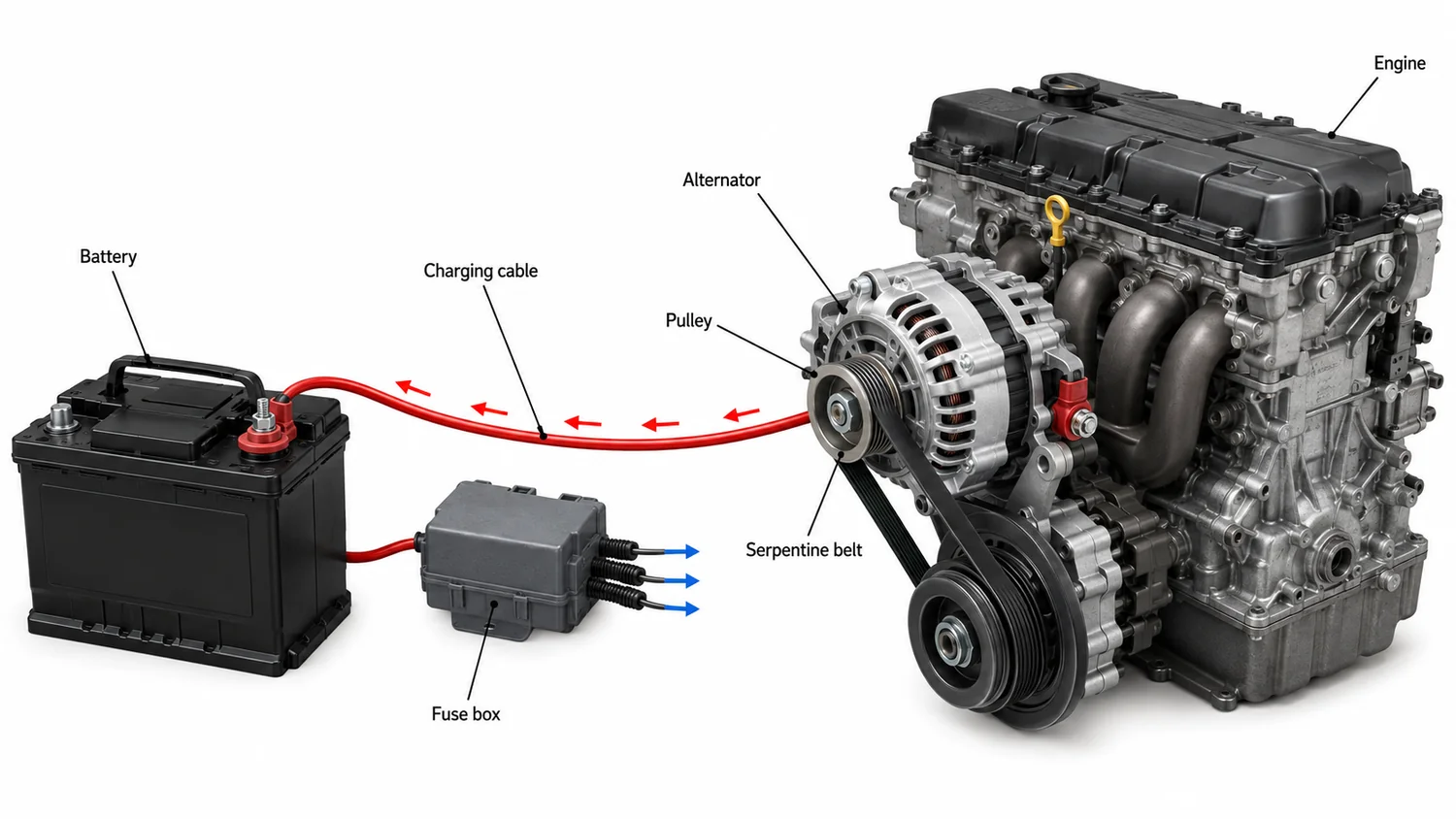
The battery starts your 2018 Hyundai Elantra; the alternator runs it. Once the engine is on, a belt spins the alternator and it generates the electricity for everything, headlights, computers, ignition, while recharging the battery for the next start. When the alternator quits, the car drains the battery and dies, which is why a bad alternator so often gets misdiagnosed as a bad battery.
Four signs it’s the alternator, not the battery
Battery light while driving
The charging system stopped keeping up. The battery is now running the car alone.
Lights dim at idle
Headlights or dash brighten with revs and dim at a stop. Classic weak-alternator output.
Whine or growl up front
A failing alternator bearing gets noisy before it dies. The pitch rises with engine speed.
Dead battery, again
A new battery that keeps dying was probably never being recharged. Test the alternator first.
The two-minute check: with the engine running, voltage at the battery should read roughly 13.5 to 14.5 volts. Low 12s means the alternator is not charging. Most parts stores run this test free.
What an alternator replacement is like on the 2018 Hyundai Elantra
The sixth-generation (AD) Elantra is one of the easier compacts to do this job on, which is why book time is short. On the 2.0L Nu engine the alternator sits at the top of the single serpentine belt run on the passenger side of the bay, reachable from above: engine cover off, air intake duct out of the way, release the spring-loaded tensioner, unplug the field connector and B+ cable, and pull two through-bolts. RepairPal's labor line of just $98 to $143 confirms this is roughly a one-hour book job, though real independent invoices land closer to 1.5 hours once charging-system verification is included. The 1.4T Eco and 1.6T Sport add turbo and intercooler plumbing at the front of the engine, which is where the extra 0.3 or so hours on those rows comes from.
There is no pattern alternator failure on this generation. Typical failures show up past 100,000 to 150,000 miles as worn brushes or voltage regulator faults (battery light, dimming at idle) or a whining pulley or bearing. What IS a documented pattern on 2017-2018 Elantras is battery drain complaints and healthy alternators being condemned: the AD uses a battery-sensor-driven smart charging system that deliberately swings system voltage from roughly 12.5V to over 15V depending on battery state of charge. Owners and even some shops read a commanded 12.8V cruise voltage as a dying alternator. Before paying for this repair, insist on a proper load test of the alternator output, not just a voltmeter reading at idle.
OE part numbers are worth knowing because they expose the pricing game. The 2.0L uses genuine part 37300-2E721 (130A, MSRP $719 to $799, sold online by dealers for $513 to $564). The 1.4T Eco uses 37300-03AA0 (MSRP $614.66, online dealer price $357 to $453). Both are built by Mando, Hyundai's OE supplier, and new Mando-branded units sell in the aftermarket for $252 to $315. That means you can buy the same manufacturer's alternator for roughly 40 to 60 percent of the genuine-boxed price.
The aftermarket channel spread is the single biggest driver of quote variation on this car. The identical remanufactured unit number for the 2.0L (11879 family) sells for about $218 online and $563 at a chain parts counter; the 130A unit (11871) runs $261 to $274 online versus $457 at retail. A shop quoting $700+ for this job on a 2.0L is almost always pricing an OEM or chain-retail part plus markup, not charging outrageous labor. One caution for the Eco: aftermarket coverage for the 1.4T alternator is thin (reman-only at major online sellers), so the genuine part at $357 to $453 online is often the sensible buy, which is why the Eco row's parts ceiling nearly touches OEM money.
No NHTSA recall on the 2018 Elantra touches the charging system, and a scan of the generation's roughly 195 published technical service bulletins turns up ECM software and battery-sensor updates but nothing directing alternator replacement. If a dealer frames this as a known defect requiring a genuine unit at $950 or more, that is a sales posture, not a service bulletin. RepairPal's widely quoted $728 to $998 range for this exact car is built on OEM-list parts pricing of $630 to $855; swap in a quality aftermarket or Mando unit at an independent shop and the realistic total drops by $300 to $400.
Estimate note: these are researched independent-shop ranges, not a guaranteed quote. The only exact number is one from a shop that has seen your car.
Frequently asked questions
How much does a 2018 Hyundai Elantra alternator replacement cost?
A 2018 Hyundai Elantra alternator replacement typically runs $315 to $770 at an independent shop, parts and labor included. The alternator itself is $190 to $460, labor makes up most of the rest, and the job takes 1 to 3 hours.Why does the price change with the engine?
The 2018 Hyundai Elantra came with more than one engine, and they do not share the same part or the same access. A tighter engine bay or extra teardown adds labor hours, and the part price moves too. Sites that show one national number flatten that out. Pick your engine on the estimate above for a closer figure.How do I know if it's the alternator or the battery?
A battery that only cranks weakly on startup but runs fine afterward is usually the battery. A battery or charging warning light while driving, headlights that dim at idle, or a car that dies while running points at the alternator. The clean test is voltage at the battery with the engine running: roughly 13.5 to 14.5 volts means the alternator is charging, low 12s means it is not. Most parts stores will test both for free, so confirm before buying either part.Can I drive my Hyundai with a bad alternator?
Only briefly. Once the alternator stops charging, the car runs off the battery alone, and depending on its charge and what is switched on you may get 30 minutes to an hour before the Hyundai dies, possibly in traffic. Turn off everything you can spare and drive straight to the shop, or have it towed if the warning light has been on a while.How long does an alternator last?
Most factory alternators last roughly 100,000 to 150,000 miles, or 7 to 12 years. Heat, short-trip driving, and heavy electrical loads shorten that. The usual failures are worn brushes, a failing voltage regulator, or a noisy bearing, and the fix is replacement rather than repair on nearly all modern units.
More 2018 Hyundai Elantra repair costs
Related charging system repairs
You deserve a fair fix.
Tell us what is wrong. A verified mechanic comes to you.