


A typical starter replacement costs $450 to $700 parts and labor at an independent shop in 2026. An easy-access truck with a remanufactured part can come in at $320 to $500, while an engine that hides its starter under the intake manifold runs $650 to $1,000, and a buried or turbo-crowded starter with a new OE part at a high-rate metro shop can reach $1,300.
That spread has almost nothing to do with the part itself. The same starter that takes one hour to swap on one engine takes three and a half on another, because on some cars the intake manifold has to come off just to reach it. Here is what a fair price looks like in 2026, how to be confident it really is the starter before you pay, and where the money actually goes.
Want your number first? The starter cost calculator prices this job for your exact year, make, and model in about thirty seconds, then come back for what's behind the number.
What Does a Starter Replacement Cost in 2026?
| Scenario | Typical price installed |
|---|---|
| Open-access truck, reman starter (F-150 5.0 V8 class) | $320 to $500 |
| Typical sedan or SUV, average access, quality reman part | $450 to $700 |
| V6 with the starter under the intake manifold (Accord/Odyssey class) | $650 to $1,000 |
| Same open-access job with a new OE-brand starter instead of a reman | $400 to $650 |
| Buried or turbo-crowded starter, new OE part, high-rate metro shop | $900 to $1,300 |
The math behind the typical job: a quality remanufactured starter runs $240 to $340 through a shop, and the swap books at 1.5 to 2.25 hours at $140 to $160 an hour, so $210 to $360 in labor. National-average sites like RepairPal publish $564 to $793 for this job because they price OE-line parts at $376 to $518, not the store-brand remans most independents actually install, which is why their range sits at the top of this band.
One note for North Carolina drivers: independent shops nationally bill $120 to $159 an hour in 2026, with the average at $132, and North Carolina labor sits below that national average, with smaller markets in the state dipping toward the $85 to $120 band that rural independents charge. Since a starter job is mostly labor on hard-access engines, that keeps quotes here at the friendlier end of every range in this guide.
Why the Same Starter Costs Double on Some Cars
As of 2026, RepairPal prices the same starter replacement at $413 to $488 on a Ford F-150 but $680 to $965 on a Honda Accord, a roughly 2x spread caused almost entirely by whether the intake manifold has to come off to reach the starter.
That is the whole game. The part is roughly $150 to $300 either way. On the F-150's 5.0 V8 the starter hangs in the open on the bell housing, a 1.0 to 1.5 hour job. On Honda's J-series V6 in the Accord and Odyssey, the starter lives under the upper intake manifold, so the manifold comes off and goes back on with new gaskets, a 2.5 to 3.5 hour job for the exact same repair. Turbo engines trend the expensive direction too: on EcoBoost F-150s, the turbo oil lines and downpipe routing add 45 to 75 minutes over the 5.0 V8.
What Are the Symptoms of a Failing Starter?
Starters usually give some warning, though the window is shorter than most parts. Watch for these:
- A single loud click when you turn the key, and nothing else. The solenoid is pulling in but the motor is not spinning, especially when the dash lights stay bright and steady.
- Intermittent no-starts that a second or third try fixes. Worn brushes or pitted contacts often work when the armature happens to stop in a good spot. A car that starts on the second try every few days is telling you something.
- A whirring or spinning noise with no engine crank. The motor is running but the pinion is not engaging the flywheel.
- A harsh grinding sound during cranking. The pinion and ring gear teeth are not meshing cleanly. Do not keep cranking through this one, because ring gear damage is a far larger repair than a starter.
- Slow, labored cranking that does not improve with a fresh battery.
- A hot-start problem. The car starts fine cold but refuses after it has been running. Heat soak raises resistance in a marginal starter.
There is also a real diagnostic hiding in an old trick: if the engine cranks after someone raps the starter housing with a wrench during a no-crank, worn brushes or a sticking solenoid plunger were momentarily freed. That confirms the starter is dying, and it will strand you again soon.
Is It the Starter or the Battery?
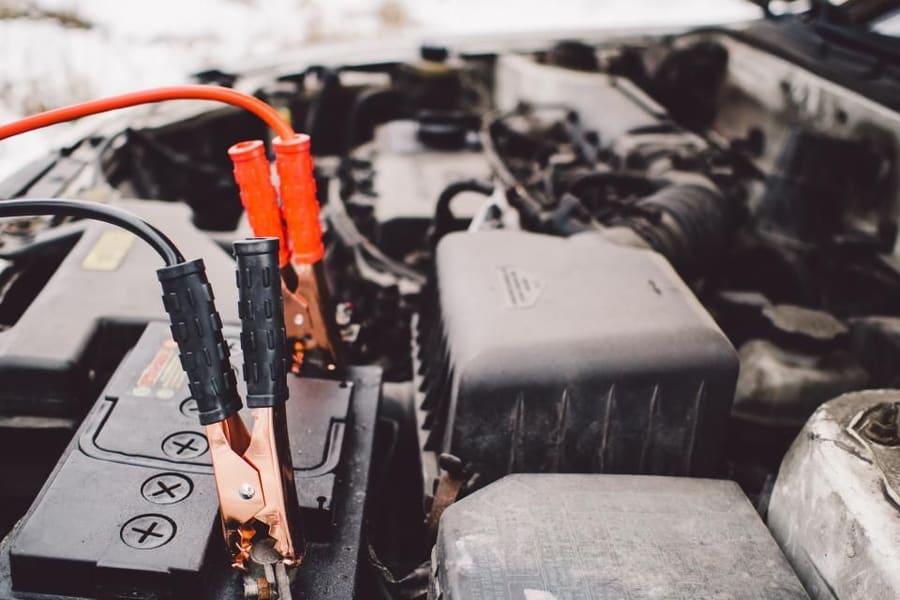
This is where the most money gets wasted, because a dead battery and a dead starter feel identical from the driver's seat. The click test does the first diagnosis free: one loud click with bright headlights usually means the solenoid is engaging but the starter motor is not spinning, while rapid machine-gun clicking points to a weak battery or bad connection, not the starter. A jump start that changes nothing also points at the starter. If the car cranks fine but will not fire, the starter is innocent entirely, and our guide on why your car won't start walks that bigger decision tree.
One caution on free testing: parts-store bench tests are theater for marginal starters. The tester spins the motor with no load, so a dying starter can pass on the bench and still fail against engine compression or when heat-soaked. Shops confirm with a voltage-drop test instead; more than 0.5V dropped across the cables means the problem is wiring, not the starter. If the verdict comes back battery, that is the cheaper outcome, and our battery replacement guide covers what that job should cost. A charging system that cannot keep the battery full can fake both failures, which is where the alternator replacement guide picks up.
Reman or New: Which Starter Should You Pay For?
Real 2026 counter prices for a 2015 F-150 at AutoZone: Duralast remanufactured starters start at $114.99 while new Duralast units run $174.99 to $204.99, all with a $40 refundable core deposit and a limited lifetime warranty. Since both carry the same warranty at the big chains, the reman is the value play, and it is what most independent shops install unless you ask for OE. A new OE-boxed starter runs $300 to $600 as a part, which is most of why dealer quotes land 30 to 40 percent above independents: dealers install only new OE parts and bill $20 to $40 an hour more, about $1,000 at a Honda dealer for an Accord V6 job an independent does for $650 to $800.
Two smaller line items worth understanding. On modern starters the solenoid is bolted to the starter body, and while a standalone solenoid is a $30 to $80 part, almost no shop installs just the solenoid because the labor to reach it is identical to full replacement. And every starter carries a core charge, typically $15 to $50; shops keep your old unit as the exchange, so that line usually never appears on your invoice.
What Drives the Price
- Starter location and access: the single biggest variable. 0.5 to 1.5 hours on open V8 trucks versus 2.5 to 3.5 hours when the intake manifold must come off, which roughly doubles the total bill for the same part.
- Reman vs new vs OE part: $115 to $175 for a store-brand reman, $175 to $310 new aftermarket, $300 to $600 OE-boxed new. All the big-chain options carry limited lifetime warranties.
- Labor rate by region and shop type: $85 to $120 an hour at rural independents, $120 to $159 at typical independents, $170 to $200 in high-cost metros, with dealers adding $20 to $40 an hour on top.
- Engine configuration: turbo engines add 45 to 75 minutes of labor for plumbing in the way, and diesel starters are physically bigger and cost $100 to $250 more as parts.
- Collateral discoveries: corroded battery cables ($50 to $150), chewed flexplate ring gear teeth (hundreds more), and manifold gasket sets on buried-starter jobs ($30 to $80) get added to the base quote.
- Diagnostic fee: $0 to $150 to confirm starter versus battery versus cables; many independents credit it toward the repair.
Starter Replacement FAQ
How do I know it is the starter and not the battery? Turn the key with the headlights on. If the lights stay bright and you get one solid click but no crank, suspect the starter. If the lights dim hard or you hear fast repeated clicking, suspect the battery or cable connections. A jump start that changes nothing also points at the starter.
Is it cheaper to rebuild a starter or replace it? Replacement almost always wins in 2026. Solenoids and brush kits cost $30 to $80, but the labor to remove the starter is identical either way, and a $115 to $175 remanufactured unit with a limited lifetime warranty erases the savings of a rebuild plus the risk of a comeback.
Can I still drive with a bad starter? Once the engine is running the starter does nothing, so the car drives normally. The gamble is every restart: a dying starter fails intermittently and gets worse, so each stop for gas or errands is a chance to be stranded. Manual cars can be push started; automatics cannot.
How long does starter replacement take? From about 30 to 45 minutes on an open-access truck like an F-150 5.0 to 3 to 4 hours on cars where the starter hides under the intake manifold, like Honda's J-series V6 in the Accord and Odyssey. Access time is why quotes for the same part vary by 2x.
Why is the dealer quote almost double the independent shop? Three stacked premiums: dealer labor rates run $20 to $40 an hour higher, dealers install only new OE-boxed starters instead of $115 to $175 remans, and dealer book times tend to be quoted at the full flat-rate hour. Together that is a 30 to 40 percent or larger gap for identical work.
Are remanufactured starters reliable? Good ones are. Denso and Bosch remans are built on original cores and factory tested, and even store brands like Duralast and O'Reilly Ultima carry limited lifetime warranties. The quality risk is at the bargain-bin bottom, not in the reman category itself.
These ranges cover the starter and installation at independent shops. They do not include sales tax or shop supply fees, the $0 to $150 diagnostic fee if you decline the repair, or towing, the most common hidden add since a no-crank car cannot drive itself in. Battery, cable, or terminal replacement runs another $50 to $200 if corrosion turns up, a manifold gasket set on buried-starter jobs sometimes appears as its own $30 to $80 parts line, and flexplate or ring gear repair can add $500 to $1,500 if the starter chewed the teeth, since the transmission may need to move. Core charges are built into shop part pricing; only DIYers front the $15 to $50 refundable deposit.