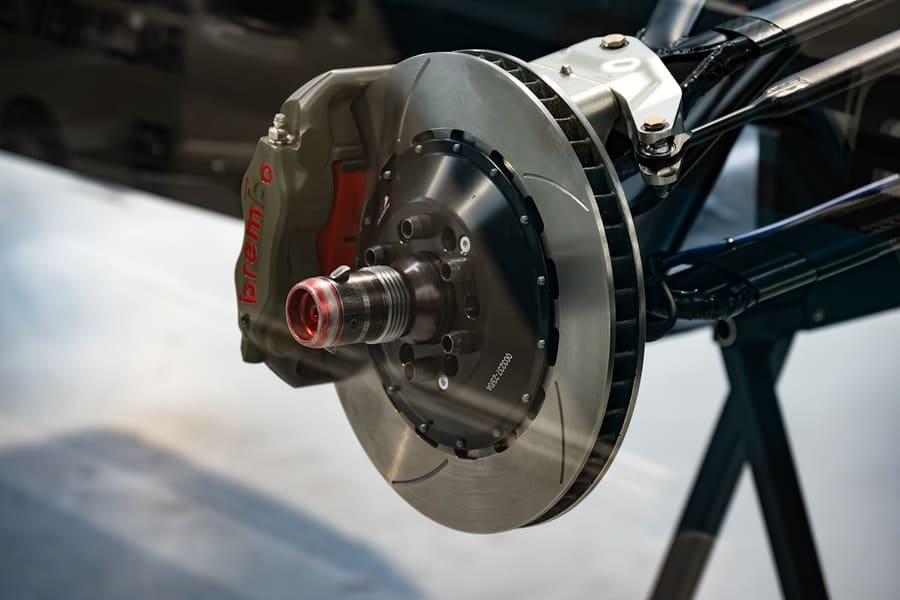



Squeaking brakes usually mean your pads are wearing thin, or, if the noise fades after a few stops on a damp morning, nothing at all. Grinding is different: it almost always means the pad material is gone and the steel backing plate is scraping your rotors, and every mile adds to the repair bill. As a rule, a squeak gives you weeks to deal with it; a grind gives you days.
That distinction matters because brake noise is easy to misread in both directions. Plenty of drivers panic over a harmless morning squeal, and plenty of others tune out a grind until a $200 pad job becomes a $700 pad-rotor-and-caliper job. At North Carolina independent-shop rates, roughly $90 to $130 an hour in Charlotte and $95 to $135 an hour in the Triangle, the difference between catching the squeal and ignoring the grind is real money. Here's how to tell which camp you're in, what each repair actually costs here, and how long you can realistically wait.
Already know which repair you're facing? The brake job cost calculator prices it for your exact year, make, and model in about thirty seconds.
Is Brake Squeaking Ever Normal?
Yes, some brake squeaking is completely normal, especially your first few stops after the car has sat overnight or in the rain. Rotors are bare cast iron, and they form a thin film of surface rust anytime they sit in damp air, which, in Carolina humidity, is most nights. Your first handful of stops scrubs that film off, which is exactly what that raspy morning squeal is. If the noise is gone after three to five gentle stops and doesn't come back until the next damp morning, it needs no repair at all.
A few other harmless squeaks: semi-metallic pads (common on trucks and performance cars) often chirp lightly when they're cold, and brake dust or a bit of road grit between the pad and rotor can sing for a day and then vanish. The pattern to watch is persistence. Noise that fades as your brakes warm up is a shrug; noise that shows up on every stop is a message.
Why Do My Brakes Squeak on Every Stop?
A squeal that happens on every stop, cold or warm, light pedal or firm, usually means your pads have worn down to their built-in wear indicator. That indicator is a small tab of hardened steel attached to the pad. When the friction material wears to roughly an eighth to a quarter inch remaining, the tab starts touching the rotor and produces a loud, deliberate squeal. It isn't a malfunction; it's the pad's way of telling you it's near the end.
Not every constant squeal is a wear indicator, though. Glazed pads (hardened by heat), missing anti-rattle shims or hardware, and bargain-bin pads with soft friction compounds all squeal too, sometimes with plenty of pad life left. You can't tell which one you have from the driver's seat, which is why a constant squeal earns an inspection. The good news: at this stage your brakes still stop the car normally. You're scheduling a repair, not surviving an emergency.
Is Grinding the Pads or the Rotors?
Grinding almost always means the pads are finished and the rotors are now being damaged, so it's both. Once the friction material wears away completely, the pad's steel backing plate presses directly against the rotor face. That metal-on-metal contact is the grind you hear, and it cuts grooves into the rotor, overheats it, and can warp it within a surprisingly short distance. Shops rarely see a grinding car that needs only pads; by the time you hear it, the rotors are usually scored past the point of resurfacing.
Two caveats worth knowing. A single scraping sound on your very first stop after the car sat for a week is often just heavy rust cleanup, the same morning-squeal story, louder. And a grind you hear while rolling without touching the brakes may be a stone caught in the caliper bracket or a failing wheel bearing rather than the brakes at all, our guide to grinding noises when turning sorts those apart. But a grind that appears when you press the pedal and gets louder as you press harder is worn-out brakes until proven otherwise.
How Much Do Brake Repairs Cost in North Carolina?
At Charlotte and Triangle independents, a straightforward pad replacement runs about $150 to $350 per axle, and the number climbs quickly once rotors and calipers join the ticket. Dealerships typically charge 20 to 40% more, and European luxury or performance vehicles can push past $700 to $900 per axle. Here's the honest range for common brake work, built from local labor rates times typical book hours:
| Repair | Typical NC cost (per axle) | What usually triggers it |
|---|---|---|
| Brake pads only | $150 to $350 | Wear-indicator squeal caught in time |
| Pads + rotors | $260 to $570 | Grinding, deep grooves, thin or warped rotors |
| Pads, rotors + caliper work | $450 to $900+ | Grinding ignored for weeks; heat-damaged calipers |
Read that table top to bottom and you're reading a timeline. The squeal stage is the cheap stage. Most of the cost of a brake job gone expensive isn't the original parts, it's the extra parts that got damaged while the noise was being ignored. For the full parts-versus-labor breakdown, see the brake job cost guide and our cost guides; if you're pricing the work locally, the brake repair in Charlotte and brake repair in Raleigh pages show verified shops and real metro pricing.
How Long Can I Safely Wait?
A brief morning squeak can wait indefinitely, a constant squeal should see a shop within a week or two, and a grind needs attention within days, driven gently in the meantime. That's the honest hierarchy. The wear-indicator squeal is designed to give you a comfortable window; pads with an eighth of an inch left still stop the car fine. Grinding has no comfortable window. Metal-on-metal braking means reduced stopping power right now, plus a bill that grows with every stop.
Some symptoms skip the line entirely. If the pedal sinks toward the floor, suddenly feels soft or spongy, the car pulls hard to one side under braking, or the brake warning light comes on, stop driving and have the car towed or inspected immediately. Those point at hydraulic problems, not worn pads, and hydraulics don't give polite warnings.
What Should I Do, in Order?
- Pin down the pattern. Note whether the noise happens only on the first few stops, on every stop, or only under hard braking, and whether it's a high squeal or a coarse grind.
- Run the warm-up test. On a quiet street, make three to five gentle stops. If the squeal fades as the brakes warm, it's very likely surface rust and you're done.
- Look at the pads if you can. On many wheels you can see the pad through the spokes. Less than about a quarter inch of material means it's time to book.
- Constant squeal? Schedule an inspection in the next week or two and drive normally until then.
- Grinding? Drive as little and as gently as possible, and get it inspected within days, not weeks.
- Sanity-check the estimate. Compare it against the table above, and ask the shop to show you the old parts, any decent shop will.
If you're stuck on step one, not sure whether what you're hearing is a squeal, a grind, or something else entirely, that's the gap Fixxr's diagnostic covers. Describe the sound, or upload a short video of it, and you'll get a ranked list of likely causes with a fair cost range for each, so you walk into a shop knowing whether you're facing a $200 visit or a $700 one.
Brakes are one of the few systems on a car that warn you clearly, loudly, and in stages. A morning squeak asks for nothing. A steady squeal asks for a phone call sometime this week. A grind asks for this week, full stop. Catch the noise at the stage you're actually in, and once the estimate is in your hand, run it through the quote scanner at is my quote fair, a photo of the estimate and about a minute gets you what that work should cost for your car in your part of North Carolina. You deserve a fair fix.