


A brake job on a mainstream car runs $180 to $300 per axle for pads only and $330 to $580 per axle for pads and rotors at an independent shop in 2026. The spread exists because "a brake job" is really several different jobs: one axle or two, pads alone or pads with rotors, a compact sedan or a half-ton truck. The same words on two quotes can describe work that legitimately differs by $700.
That is also why brake pricing attracts more confusion than almost any other repair. A "$99 brakes" ad and a $1,000 estimate can both be honest; they are just describing different jobs. Here is what each version should cost, and how to read the quote in front of you.
Want your number first? The brake job cost calculator prices this job for your exact year, make, and model in about thirty seconds, then come back for what's behind the number.
What Does a Brake Job Cost in 2026?
| Scenario | Typical price installed |
|---|---|
| Pads only, one axle (quality ceramic pads) | $180 to $300 |
| Pads plus rotors, one axle | $330 to $580 |
| Pads plus rotors, all four wheels | $660 to $1,120 |
| Pads, rotors, and both calipers, one axle | $590 to $1,160 |
| Truck or European premium, pads plus rotors, one axle | $460 to $900 |
| Rear axle with electronic parking brake, pads plus rotors | $380 to $680 |
The math behind the most common ticket, pads plus rotors on one axle: parts run $190 to $320 (a pad set at $60 to $100, two rotors at $60 to $95 each, and a $15 to $25 hardware kit), then the shop adds 1.3 to 1.8 hours of labor at typical 2026 independent rates of $110 to $150 per hour, so $140 to $260. A pads-and-rotors job on one axle of a mainstream car runs $330 to $580 at US independent shops in 2026, while blended national estimators like RepairPal price the same axle at $901 to $1,084, a gap of roughly 60 percent driven by dealer parts and dealer labor rates. Neither number is a lie; the estimator is just averaging in dealer OE parts and $180-plus hourly rates that an independent shop does not charge.
Why "Per Axle" Is the Only Honest Brake Unit
Pads come in sets that do one axle: both front wheels or both rear wheels. So any brake quote that does not say which axle and how many axles is hiding something. That famous "$99 brakes" special is real but narrow: one axle, pads only, the cheapest friction material, and it assumes your rotors pass inspection.
Fronts and rears also wear on completely different clocks. Front pads do roughly 70 percent of the stopping and wear about twice as fast as rears, so a recommendation to do all four wheels at once deserves a measurement in millimeters, not a trust fall. Most cars simply never need all four axles on the same day.
Pad material is the other axle-level choice. Ceramic pads at $50 to $100 per axle set retail are the independent-shop default for passenger cars: quiet and low dust. Semi-metallic pads at $40 to $80 bite better under heat and are still the right call for towing and heavy trucks, which is one reason truck brake tickets differ, and not just because of size.
Why Shops Don't Machine Rotors Anymore
Rotor machining is effectively dead in 2026. Modern rotors are built thin for fuel economy and sit close to their minimum-thickness spec by the time the pads wear out, and lathe labor costs about as much as a new $60 to $95 mainstream rotor. So shops replace rather than turn, and once a rotor is scored or below spec, new rotors are the only real option.
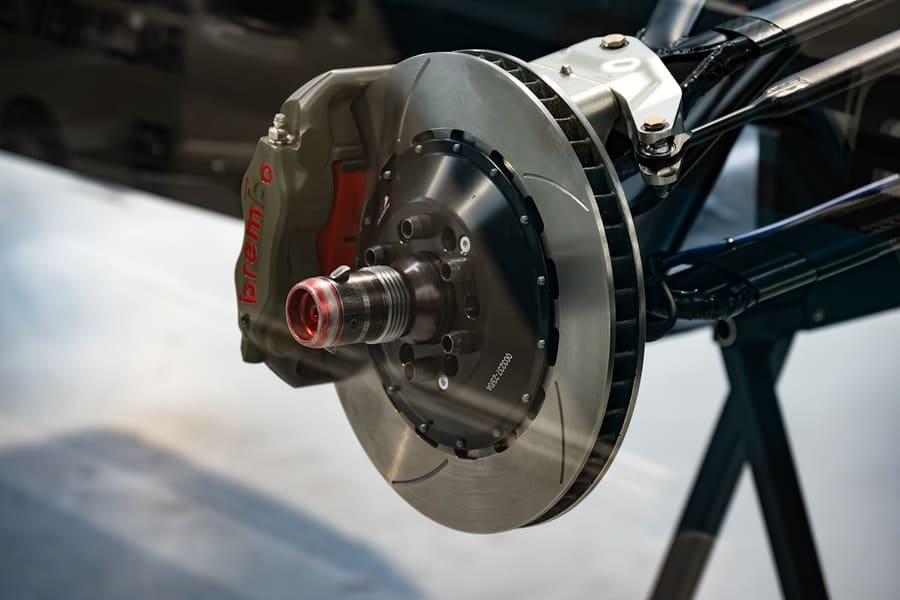
Rotors are also priced each while pads are priced per axle set. A "pads and rotors" axle is one pad set plus two rotors, which is why the parts line roughly triples versus pads alone: $190 to $320 against $60 to $110. Pads-only at $180 to $300 is still legitimate when the rotors measure above minimum thickness and are smooth, and a good shop will show you the measurement when you ask. If your pedal pulses or your steering wheel shakes when braking, the rotors have already answered the question.
The $20 Line Item That Predicts a Good Brake Job
A $15 to $25 hardware kit, meaning abutment clips, shims, and slide-pin lube, should appear on every pad job invoice. Reusing rusted clips is the top cause of squeal comebacks, and the kit's absence is a sign of a corner-cut job. If you are booking brakes because of a noise, our guide to what squeaking and grinding actually mean helps you tell a wear indicator from metal-on-metal damage before the wheels come off.
Labor on the rest of the job is book-time based: about 1.0 to 1.3 hours per axle for pads only and 1.3 to 1.8 hours for pads plus rotors, billed at $110 to $150 per hour at independents versus $180 or more at dealers. Hours far above that range on a routine axle are worth a question.
Why Rear Brakes Now Cost More Than Fronts
Rear brakes on most cars built since about 2018 have an electronic parking brake. The rear caliper pistons are moved by electric motors that must be retracted with a scan tool in service mode before the pads come out, which is why a rear axle can quote higher than the front axle on the same car: $380 to $680 with the EPB steps, including a scan-tool line item of $25 to $70 at shops that itemize it. This one is not an upsell. Forcing the piston back without the tool can destroy a $300 to $600 caliper actuator, turning a routine pad job into a caliper replacement.
What Drives the Price
- Which axle and how many axles: front only, rear only, or all four roughly sets the multiplier; all four is near double one axle minus a small single-visit savings.
- Pads only versus pads plus rotors: adding two rotors adds $120 to $360 in parts plus about half an hour of labor per axle, and since machining is dead, worn rotors mean new rotors.
- Vehicle size and brand: full-size truck rotors carry nearly twice the material of a compact car's, adding $100 to $200 per axle; European OEM pads and required wear sensors add $100 to $250 per axle. An F-150 rotor is nearly twice the size of a Civic's, and BMW OEM pads run $180 to $280 per axle versus $60 to $120 mainstream.
- Local labor rate: independents bill roughly $110 to $150 per hour in 2026 depending on state and metro; dealers typically run $20 to $40 more per hour and often past $180.
- Parts grade chosen: economy versus premium ceramic versus OEM can swing the parts line 2x to 3x on the identical job, and warranty length usually tracks the grade.
- Electronic parking brake on the rear axle: adds scan-tool service-mode steps worth $25 to $75 on most 2018-and-newer vehicles.
- Condition surprises: rust-belt cars with frozen slide pins or a dragging caliper can add $200 to $580 per axle once calipers and a brake bleed enter the ticket.
Brake Job Cost FAQ
How much does it cost to replace brake pads and rotors in 2026? At an independent shop, plan on $330 to $580 per axle for a mainstream car: roughly $190 to $320 in parts (one pad set, two rotors, hardware) and $140 to $260 in labor. Trucks and European cars run $460 to $900 per axle. Dealer quotes for the same work commonly land 40 to 80 percent higher because of OE parts and higher hourly rates.
Do I have to replace rotors every time I get new brake pads? No. If rotors measure above minimum thickness and are smooth, pads alone at $180 to $300 per axle is legitimate. But shops almost never machine rotors anymore because modern rotors are thin and lathe labor costs as much as a new rotor, so once a rotor is scored or below spec, replacement is the only real option.
Why is my quote so much higher than the price of the parts online? Labor and warranty. Parts for one mainstream axle are $190 to $320 retail, then the shop adds 1.3 to 1.8 hours at $110 to $150 per hour, a hardware kit, shop supplies, and a parts-and-labor warranty. Shops also mark up parts over wholesale, which is standard and funds the warranty when a pad set fails early.
Is a $99 or $149 brake special real? It is real but narrow: one axle, pads only, the cheapest friction material, and it assumes your rotors pass inspection. Most cars that squeal long enough to book an appointment also need rotors, so the average special turns into a $330 to $580 per-axle ticket once the wheels are off. That is upsell math, not necessarily a scam.
Why do rear brakes cost more than fronts on my newer car? If your car has an electronic parking brake, and most 2018 and newer do, the rear caliper pistons are moved by electric motors that must be retracted with a scan tool in service mode before the pads come out. That adds time or a $25 to $75 line item, and forcing the piston without the tool can destroy a $300 to $600 caliper.
Should I do all four wheels at once? Only if measurements say so. Fronts do about 70 percent of the braking and wear roughly twice as fast, so needing all four at the same time is the exception. Ask for pad thickness in millimeters per axle; anything above about 5 mm on the other axle can usually wait.
These ranges cover pads, rotors, hardware, and installation at independent shops. They do not include sales tax, shop supplies, and disposal fees, which typically add 5 to 12 percent to the ticket, or a brake fluid flush at $90 to $150, recommended every 2 to 3 years but billed as a separate service unless the hydraulic system was opened. Caliper work beyond the scenario above is its own job, covered in our brake caliper replacement cost guide, and a seized or leaking caliper adds $80 to $180 per reman part plus bleed labor. Also excluded: drum brake shoe service on older rears, wheel bearing, hub, ABS sensor, or brake hose problems discovered once the wheel is off, seized-fastener extraction on rust-belt cars billed as added time, and diagnostic or inspection fees, which many shops waive only if you approve the repair.