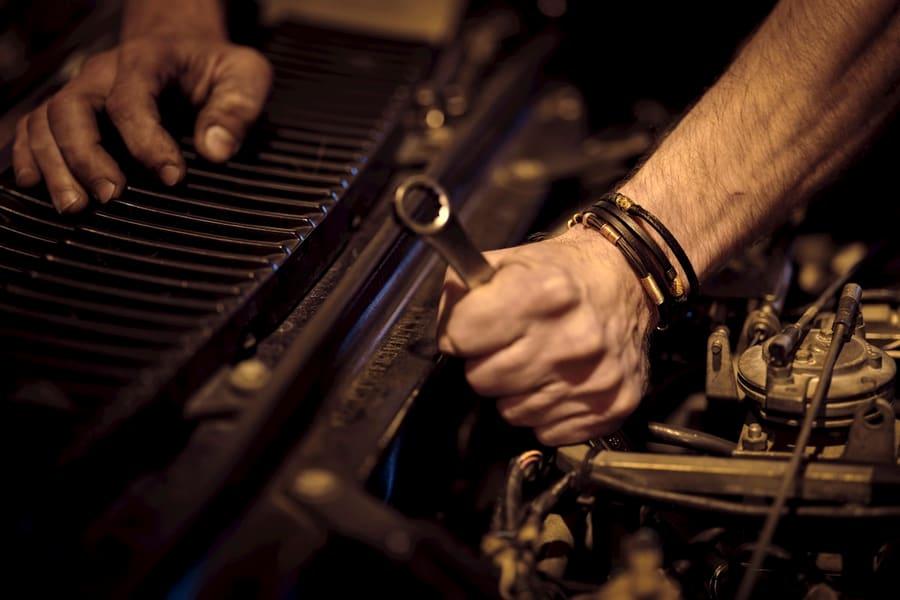



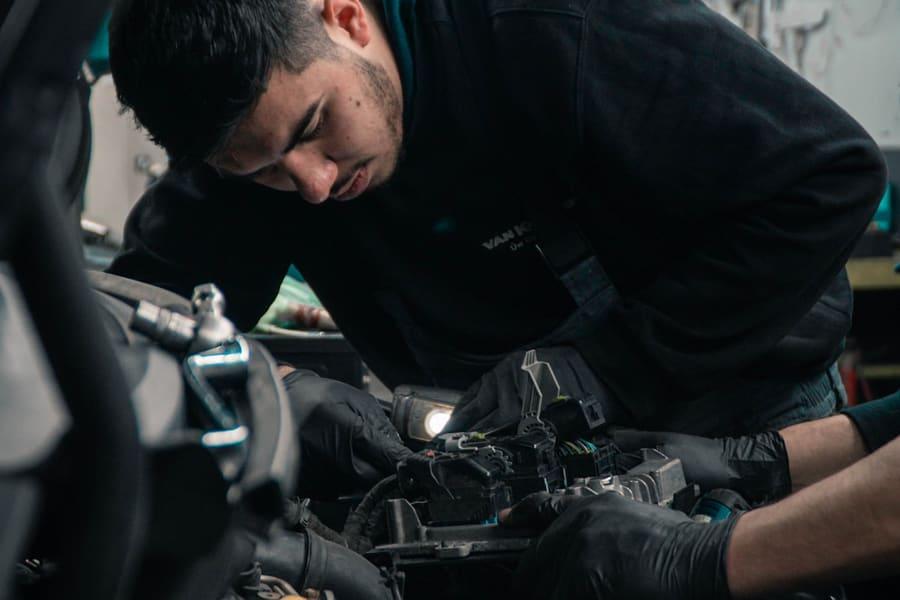
Two smells, two very different problems. A hot, oily, slightly acrid smell, the one that shows up when you stop at a light after a drive, almost always means engine oil is leaking onto something hot, usually the exhaust manifold. A sharp burning-rubber smell almost always means rubber is being rubbed or cooked: a slipping drive belt, a brake that is dragging, or a hose resting where it should not be.
Neither is something to live with for a month, but only some of them mean pull over now. The good news is you can usually tell them apart in your own driveway in five minutes, without tools and without paying for a diagnosis first. Most of these repairs land between $90 and $500; a couple climb past a thousand. Treat every number here as a ballpark to check a quote against, not a guaranteed price for your car.
Want your number first? The car repair cost calculator prices this job for your exact year, make, and model in about thirty seconds.
What Does a Burning Oil Smell Actually Mean?
Oil has to land on something hot to make a smell. The exhaust manifold, the cast-iron piece bolted to the side of the engine that collects exhaust from each cylinder, runs hot enough to cook oil on contact. So a burning-oil smell is really a leak report, and the leak is almost always above or beside that manifold.
The usual sources, roughly in order of how often they turn up:
- Valve cover gasket. The valve cover sits on top of the engine, and its gasket is the most common oil leak on a high-mileage car. Oil weeps over the edge, runs down the block, and lands on the manifold. Classic symptom: strongest after a highway drive, when you stop and heat soaks into everything.
- Oil left behind after a service. A spill during an oil change, or a filter or drain plug that did not seal cleanly, will smoke for a few drives. If the smell started within a day or two of an oil change, suspect this first and call that shop.
- Oil pan gasket or drain plug. Lower down, so it is likelier to leave drips on your driveway than to smell, though it can still reach the exhaust where the pipe runs close to the pan.
- Rear main seal. Where the crankshaft exits the back of the engine. Less common, more expensive, and it usually shows up as drips at the very back of the pan.
- Power steering or transmission fluid, which smell more chemical and sweeter-burnt than motor oil but reach hot parts the same way.
One important distinction: burning oil you smell outside the car is a leak dripping onto something hot. Blue-tinged smoke out the tailpipe is oil being burned inside the engine, which is a different problem, our guide to what white, blue, and black exhaust smoke mean sorts that out.
What Does a Burning Rubber Smell Mean?
Rubber smells come from friction and heat, and only a handful of places on a car produce either in quantity.
- A slipping serpentine belt. The single flat, ribbed belt that snakes around the front of the engine and drives your alternator, water pump, power steering, and AC compressor. When it glazes over or the tensioner weakens, it slips against a pulley and the rubber burns. Usually paired with a squeal on startup or at full steering lock.
- A dragging brake. A caliper that is not releasing holds the pad against the rotor, and the friction material cooks. The tell is that you smell it after driving rather than while braking, and one wheel runs much hotter than the others. It often comes with a pull to one side.
- A clutch, on a manual. A worn clutch slipping under load smells like burning carpet. If the revs climb without the car speeding up, that is a slipping clutch, not just a smell.
- A hose or wire touching something hot. Plastic that shifted after a repair, or a clamp that let go, melts against an exhaust pipe. Cheap, easy to spot, worth ruling out first.
- Overheating in general. A burning smell with a climbing temperature gauge is an overheating problem first, see what to do in the first 60 seconds.
Two smells belong in a different family. A sweet, syrupy smell is coolant, which means a cooling-system leak. An electrical burning smell, sharp and plasticky, like a hot appliance, is wiring insulation overheating. That one gets its own rule below.
The Five-Minute Driveway Check
Do this cold, in daylight, engine off, car on level ground. You are not fixing anything; you are narrowing the list.
- Look for a stain before you look for a leak. Slide a flattened cardboard box under the engine overnight. In the morning, note where the drips landed and what color they are. Brown or black is engine oil. Reddish-brown is transmission or power steering fluid. Green, orange, or pink is coolant. Clear and watery is usually just AC condensation, which is normal.
- Look at the top of the engine. Follow the seam where the valve cover meets the engine. A wet, dark, grimy line along that seam is a leaking gasket, dust sticks to fresh oil, so leaks look like dirty streaks more than clean puddles.
- Look at the exhaust manifold side. You want a baked-on, darkened patch, or wisps of smoke once the engine is warm. That patch tells you where the oil is landing, which points back up to where it came from.
- Inspect the serpentine belt. With the engine off, look at the ribbed side. Fine cracks across the ribs, missing chunks, or a shiny glazed surface all mean the belt is done. Press the longest free span: it should feel taut, not floppy.
- Feel your wheels after a drive. Drive a few minutes without heavy braking, park, and hold your hand near each wheel, near, not on, because a dragging brake gets hot enough to burn you. One wheel much hotter than the other three points straight at a dragging caliper, and our brake caliper cost guide covers the inexpensive slide-pin fix worth asking about first.
- Check your oil level. Pull the dipstick, wipe it, reinsert, pull again. A level that is noticeably low confirms you are losing oil somewhere.
Write down what you find. Walking in and saying "smells hot and oily after highway driving, dark streak down the left side of the engine, oil a quart low" turns an hour of diagnosis into fifteen minutes.
What Does the Timing of the Smell Tell You?
When a smell shows up rules out more than the smell itself does.
- Once you stop, strongest at idle or parked, a leak onto the exhaust. Air is no longer moving through the engine bay, so fumes drift up through the hood gaps.
- On a cold start, fading after a minute, a belt that slips until it warms and grips.
- Only at full steering lock or when the AC kicks on, belt again. Both suddenly load it.
- After a long downhill or heavy stop-and-go, brakes. Hot brakes after hard use are normal; smelling them after gentle driving is not.
- Under acceleration, revs climbing faster than the car, a slipping clutch.
- Right after a repair or an oil change, spilled fluid, or something not seated. Call the shop that did the work first.
Which Smells Mean Stop Now, and Which Can Wait?
Here is the honest split.
Pull over and shut it off now if: the temperature gauge is climbing or you see steam; you smell sharp electrical burning or see smoke from the dash or steering column; there is any flame or smoke from under the hood; or the oil pressure light is on. Wiring fires give little warning, and driving on an oil pressure light destroys engines in minutes.
Get it looked at this week if you smell burning oil consistently and your oil level is dropping, running low is how a cheap gasket becomes an engine. Same if the belt squeals along with the smell, because a serpentine belt that snaps takes your alternator, water pump, and power steering with it, all at once. And same if one wheel runs hot: a dragging brake cooks the pad and warps the rotor, turning a modest repair into a bigger one.
You have a little time if the smell is faint, appeared right after an oil change, and fades each drive, give it two or three drives, then go back to that shop if it is still there. Same for a slow weep with no drop in oil level and no smoke: monitor it, keep checking the dipstick, and mention it at your next service.
What is not on any of these lists is "ignore it." Every one of these is a leak, a slip, or a drag, and none of them heals.
What Do These Repairs Typically Cost?
Parts-plus-labor ballparks at independent-shop rates. Local labor runs about $90 to $135 an hour around Charlotte and the Raleigh area, below the national band, which is why the same job often prices lower here than the averages you find online.
| Repair | Typical parts | Labor hours (at $90 to $135/hr) | Typical total |
|---|---|---|---|
| Oil filter or drain plug re-seal after a service | $0 to $25 | 0.3 to 0.6 hr ($27 to $80) | $30 to $110 |
| Serpentine belt replacement | $25 to $80 | 0.5 to 1.3 hrs ($45 to $175) | $90 to $250 |
| Belt tensioner or idler pulley | $45 to $180 | 0.8 to 1.8 hrs ($72 to $245) | $130 to $430 |
| Valve cover gasket (4-cylinder) | $25 to $90 | 1.0 to 2.5 hrs ($90 to $340) | $120 to $430 |
| Radiator or heater hose (coolant smell) | $25 to $120 | 0.7 to 2.5 hrs ($65 to $340) | $100 to $380 |
| Dragging brake caliper, one corner | $150 to $250 | 1.0 to 1.5 hrs ($90 to $200) | $250 to $450 |
| Oil pan gasket | $40 to $150 | 2.0 to 5.0 hrs ($180 to $675) | $220 to $830 |
| Rear main seal | $30 to $120 | 5.0 to 9.0 hrs ($450 to $1,215) | $480 to $1,340 |
A few honest notes on reading that table:
- The labor spread is the whole story on oil leaks. The gasket is a $30 part on most cars. What you are paying for is access, a 4-cylinder valve cover is about an hour, while the rear bank on a transverse V6 can mean pulling the intake manifold and triple the time. Ask which one your car is and the bill will make sense.
- Replacing the tensioner with the belt is genuinely in your interest, not padding. The tensioner holds belt pressure, and a weak one is often what glazed the belt in the first place. The belt comes off either way, so bundling costs the part and almost no extra labor. Skipping it means paying that labor twice.
- Cleaning the area is part of a real leak diagnosis. A shop that degreases the engine and asks you back in a week is not stalling. On an engine coated in old oil, that is the only reliable way to tell which of three seams is leaking now.
- A clutch is the outlier. If the smell traces back to a slipping clutch on a manual, that is a four-figure job on most cars, because the transmission has to come out.
For the same parts-plus-labor breakdown across dozens of other repairs, our cost guides are built the same way.
Why Do Gaskets Leak and Belts Slip in the First Place?
Because both are rubber, and rubber has a working life measured in heat cycles.
A gasket is a soft material squeezed between two hard ones. Every warm-up and cool-down, the metal expands and contracts and the gasket flexes to hold the seal. After enough cycles the material hardens, stops rebounding, and weeps. Nothing went wrong, the part did its job for 100,000 miles and reached the end of it. Long stretches of summer heat speed this up, which is why a car that never leaked in spring can start weeping in August.
A serpentine belt wears the same way: the ribs round off, the rubber glazes, and it stops gripping. Oil makes it far worse. A belt sitting under a leaking valve cover absorbs oil, swells, and slips, which is how one problem quietly creates the second, and why both smells so often show up on the same car. Neither part has a strict replacement interval on most cars. The maintenance is noticing early, which is exactly what the smell let you do.
What Should You Ask the Shop?
Three questions cover most of it:
- "Where is it leaking from, and can you show me?" A real diagnosis names a specific seam, valve cover, oil pan, rear main, and can point at wet metal. "It's leaking oil" is a starting point, not an answer.
- "How many book hours is that job on this car?" Book time is the industry's standard labor estimate for a repair. Multiply it by the shop's hourly rate and you can see exactly how the labor line was built.
- "Is anything else worth doing while it is open?" Sometimes the honest answer is no. When it is yes, a belt that comes off anyway, a tensioner behind the same cover, bundling saves you a second labor charge. Ask for the reason, and a good shop will give you one.
Shops answer these questions all day. The mechanics behind Fixxr are shop people themselves, and the pattern holds every time: the shop that walks you to the car, points at the wet seam, and explains the hours is the one you go back to for the next ten years.
If you already have a written estimate and just want to know whether the number lands in the right range, run it through Fixxr's quote scanner at is my quote fair. Snap a photo of the estimate, tell us the vehicle, and your diagnostic comes back in about a minute with what that repair typically costs for your car in your area. It is free, and it turns "I hope this is reasonable" into "I know what this should cost." You deserve a fair fix.