


A mechanic's time costs more than most drivers think and less than the bill makes it look. In 2026, roughly half of US independent repair shops bill $120 to $159 an hour (PartsTech's survey of 752 shops, a figure AAA cites too), dealership service departments typically quote $150 to $250, and only about 6% of shops still charge under $100. A standalone diagnostic typically costs $100 to $150, which buys you roughly an hour of a technician's testing time.
But the hourly rate is only half the story, because almost no shop bills you by the clock. They bill by book time, published flat-rate hours for each job, and the difference between understanding that system and not understanding it is the difference between reading your estimate and squinting at it. Here's how mechanic pricing actually works, what the pieces cost, and where honest shops genuinely differ from each other.
Want your number first? The repair cost calculator prices a specific job for your exact year, make, and model in about thirty seconds, then come back for what's behind the number.
What Does a Mechanic Charge Per Hour?
The posted hourly rate is the foundation of every repair bill, and it varies mostly by what kind of building the mechanic works in:
| Where the work happens | Typical 2026 hourly rate |
|---|---|
| Independent repair shop (most of the country) | $110 to $160 |
| Independent shop, rural markets | $85 to $120 |
| Independent shop, big coastal metros | $170 to $200 |
| Dealership service department | $150 to $250 |
| Luxury-brand dealership (BMW, Mercedes, Audi) | $200+ |
| Mobile mechanic | roughly $80 to $120, often quoted per job |
Two honest notes on that table. First, there is no single "national average" everyone agrees on. Surveys of shops, invoice data, and state-by-state roundups produce figures anywhere from about $110 to $160 an hour depending on how they measure. The $132-an-hour national average our car repair cost guide uses sits right in the middle, and the best-supported single survey band (PartsTech, asking hundreds of shops directly) is $120 to $159. Second, the sub-$100 shop is nearly extinct: parts, insurance, tooling, and technician pay have pushed the whole industry up. A $135-an-hour quote in 2026 isn't a shop reaching. It's the middle of the market.
What Is "Book Time," and Why Don't You Pay by the Clock?
Almost every shop in America (dealer, independent, or chain) prices labor from a flat-rate guide (Mitchell, ALLDATA, or the manufacturer's own manual) that assigns standard hours to each job on each vehicle. A starter on your particular car might book at 2.0 hours. You pay 2.0 hours times the shop's rate whether the tech finishes in 90 minutes or fights rusted bolts for three hours.
This system is fairer than it sounds, and AAA's own explainer lays it out candidly for the same reason mechanics do: it makes the price predictable and it rewards skill instead of slowness. A tech who beats book time earned it with experience and good tooling; one who runs over eats the difference. What it means for you is simple and useful: any estimate can be checked by multiplying the book hours by the posted rate. If a routine job's hours look far beyond what the guides publish, that's a fair question to ask, and a good shop will show you the guide.
What Does a Diagnostic Fee Actually Buy?
A diagnostic typically runs $100 to $150. Independent shops start around $80, and RepairPal's national fair-price band for a check-engine diagnosis is $122 to $233 in labor. It buys roughly an hour of real testing: scanning, sensor readings, visual inspection, and a test drive. That's not a fee for plugging in a code reader, which the parts store does free. It's the skilled work of turning a code into a confirmed cause, which is exactly the step that keeps you from replacing a $2,500 catalytic converter when a $200 sensor was the problem.
Diagnosis is also getting more valuable, not less. CarMD's 2026 Vehicle Health Index put the average check-engine-light repair at a record $554, up 33% in a year, with the labor share up 51%. Modern cars are computers with wheels, and the diagnostic hour is where the expertise lives. On complex electrical faults, the diagnosis can honestly cost more than the fix, and that's not a shop failing you. It's where the actual work was.
Where Do Mechanics Agree, and Where Do They Differ?
The industry's own data and the shops themselves agree on more than you'd expect. Where virtually everyone agrees:
- Book time is universal. Dealer or independent, the labor line comes from a published guide, and you can ask to see it.
- Dealers cost more than independents. Every source agrees on the direction, whether they peg it at $20 to $40 an hour or 25%+ per repair.
- Diagnosis is billable expert work, normally about an hour to an hour and a half.
- Every shop marks up parts, on roughly the same sliding scale: bigger percentage on cheap parts, smaller on expensive assemblies. The markup funds ordering, stocking, and standing behind the part if it fails.
Where honest shops genuinely differ, and where it pays to ask:
- Whether the diagnostic fee is credited toward the repair. Many shops apply it if you approve the work; a growing number don't. Neither policy is wrong, but you should know before you drop the car off.
- Minimum billing. Some shops bill in tenths of an hour; others have a hard one-hour minimum. No industry standard exists.
- OEM vs. aftermarket defaults. Dealers quote OEM parts almost exclusively; independents usually default to quality aftermarket and will offer you the choice. The same repair can differ hundreds of dollars on parts selection alone.
- Mobile vs. shop economics. Mobile mechanics skip the building and often beat shop pricing on straightforward jobs, though quoted rates range widely (roughly $80 to $120 an hour), and travel fees can close the gap. Get the out-the-door number either way.
How Much Does a Mechanic Cost in North Carolina?
Here's some genuinely good news for local drivers: North Carolina runs below the national band. Independent shops in Charlotte generally bill $90 to $130 an hour and the Raleigh-Durham Triangle about $95 to $135, meaning the same book-time job that costs $160 an hour in a coastal metro gets done here by the same caliber of technician for meaningfully less. Dealership rates in the state typically post in the same $150-to-$250 national range, so the independent-vs-dealer gap is, if anything, wider here.
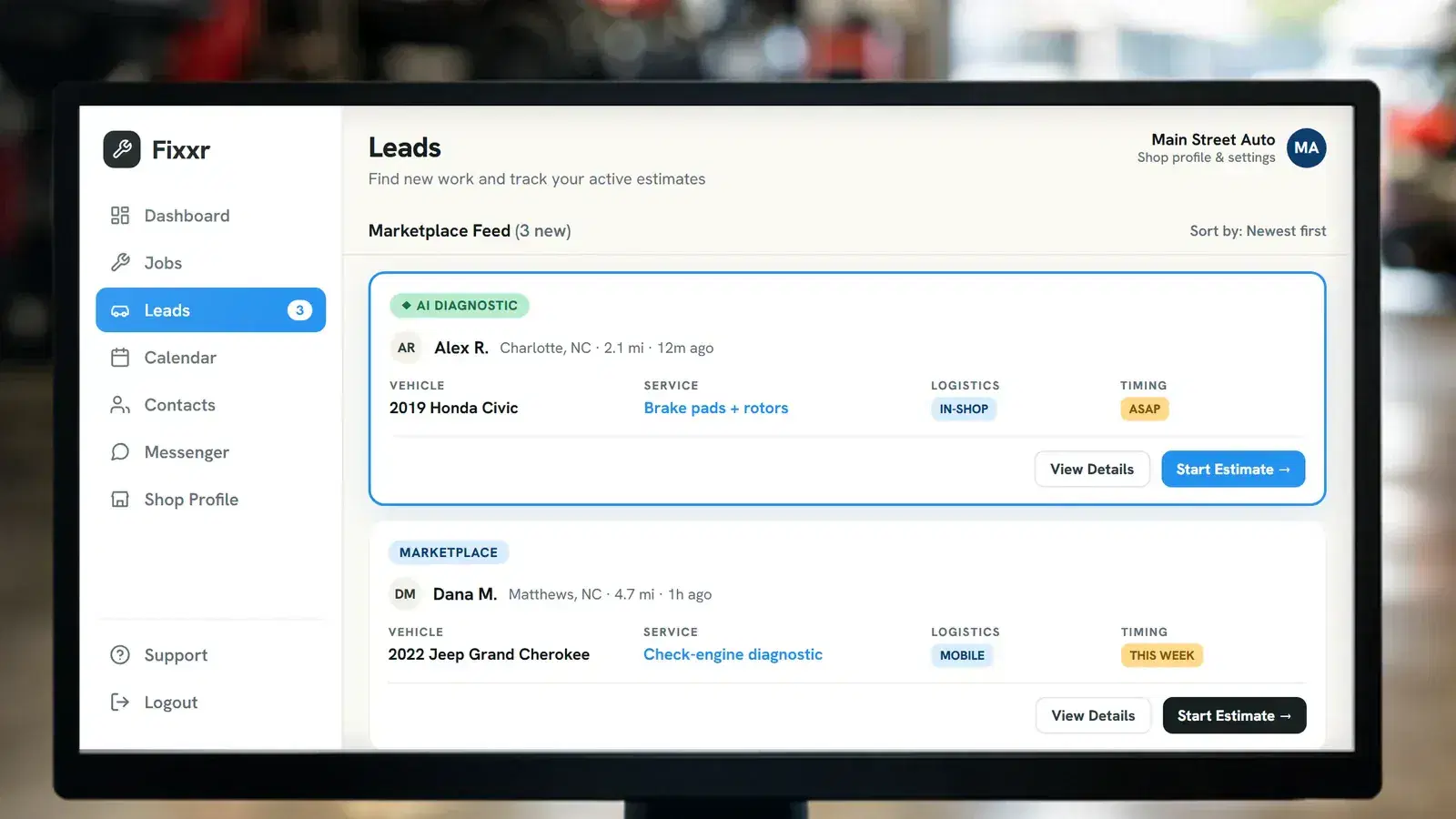
Mobile mechanics in Charlotte and around the Triangle handle a long list of common jobs (brakes, batteries, alternators, diagnostics) in your driveway. Fixxr charges a $150 visit fee for a mechanic to come out and diagnose, and it comes straight off your bill when we do the repair, which saves you the tow the next time the car won't start at your house anyway.
How Do You Read a Labor Estimate?
Every estimate is built from three checkable numbers:
- The rate. Ask for the shop's posted hourly rate. Every legitimate shop answers instantly.
- The hours. Ask whether the labor line is book time and from which guide. Multiply hours × rate and confirm the math matches the estimate.
- The parts. Ask whether each part is OEM, aftermarket, or remanufactured, and what the warranty is. That answer explains most of the difference between two quotes for the same job.
A shop that answers all three without friction is a shop pricing in the open, and most shops answer them easily. The estimate that can't survive those three questions is the one that deserves a second opinion. Our cost guides show what the common jobs should run so you have a baseline before you ever call, and our guide to reading a repair quote goes line by line.
And when the estimate is actually in your hand, run it through Fixxr's quote scanner at is my quote fair. Snap a photo, tell us the vehicle, and in about a minute your diagnostic checks the labor hours, the rate, and the parts pricing against real data for your exact year, make, and model in your area. Mechanics aren't expensive because they're out to get you. They're expensive because modern cars are hard and good hands are scarce. Pay the fair price for real work, skip the rest. You deserve a fair fix.