


A timing belt replacement done right runs $850 to $1,400 at an independent shop in 2026, and "done right" means the full kit: belt, water pump, tensioner, and idler pulleys in one visit. A belt-only job on a simple four-cylinder runs $400 to $750, but most shops will push back on that quote, and they are right to, because everything else that wears sits behind the same covers. On an interference engine, which most belt-driven engines are, waiting too long turns the whole conversation into $2,500 to $6,500 of valve or engine work.
Almost none of that money is the part. The belt itself sells for $26 to $59 retail at AutoZone and O'Reilly, and labor makes up 65 to 85 percent of the bill. Here is what the job should cost, how to know if your car even has a belt, when it is genuinely due, and why the water pump always rides along.
Want your number first? The timing belt cost calculator prices this job for your exact year, make, and model in about thirty seconds, then come back for what's behind the number.
What Does a Timing Belt Replacement Cost in 2026?
| Scenario | Typical price installed |
|---|---|
| Belt only, simple 4-cylinder (older Civic, Corolla, Elantra class) | $400 to $750 |
| Full kit with water pump, tensioner, idlers (the honest quote) | $850 to $1,400 |
| Wet belt replacement (Ford 1.0 EcoBoost Fiesta/Focus, 2014 to 2019) | $1,200 to $2,000 |
| Timing chain replacement, for contrast | $1,100 to $2,700 |
| Belt snapped on an interference engine (bent valves) | $2,500 to $6,500 |
The math behind the kit job: an Aisin timing kit with water pump, tensioner, and idlers for a Honda V6 runs $187 to $228 retail, or $280 to $450 with shop markup, plus coolant, so figure roughly $310 in parts on the low end. Add 4.5 hours of book time at $120 per hour, another $540, and you land at $850. At a $160 metro rate over 5.5 hours with $520 in parts, the same job reaches $1,400. RepairPal's 2026 national estimate for a timing belt replacement is $889 to $1,291, and $589 to $865 of that is labor, meaning roughly two out of every three dollars pay for the mechanic's time, not the $26 to $59 belt. National-average sites blend dealer, chain, and independent quotes, which is why their numbers sit at or above lean independent pricing; a dealer package on the same Honda V6 job has run $1,395 and up for the same Aisin-grade parts. For how this job stacks up against everything else on the maintenance schedule, see what car repairs cost in 2026.
When Is a Timing Belt Actually Due?
Replacement intervals run 60,000 to 105,000 miles or 7 to 10 years, whichever comes first. There is no universal number: Honda and Acura V6s call for 105,000 miles or 7 years, while many older engines specified 60,000.
The years matter as much as the miles, and that is the part people miss. Timing belts are reinforced rubber, and rubber ages with heat and time whether the car is driven or not. A 12-year-old car with 45,000 miles is running on a belt past its service life even though the odometer says otherwise. This comes up constantly with low-mileage used cars: if there is no record of the belt ever being done and the car is past the age threshold, treat it as due now.
One more wrinkle: the belt rarely gives you warning. It is sealed behind covers, it does not squeal like an accessory belt, and it usually looks fine right up until it does not. Belts fail from age and internal cord fatigue, not just visible cracking, which is why this is an interval-based job and not a wait-for-symptoms job.
Does My Car Have a Timing Belt or a Chain?
Check the owner's manual maintenance schedule. If it lists a timing belt at 60,000 to 105,000 miles, you have a belt. Chains have no scheduled replacement and normally last 100,000 to 250,000 miles with good oil changes, which is why most cars built after the mid-2010s use them. The big exceptions are Honda and Acura V6s through 2020 and Ford's wet-belt EcoBoost engines.
Wet belts deserve their own warning. On the Ford 1.0 EcoBoost (and some Peugeot 1.2 PureTech engines), the belt runs inside the engine, bathed in oil. As it degrades it sheds rubber into that oil, clogging the oil pump pickup screen and starving the engine. That is why a wet-belt replacement runs $1,200 to $2,000, and why a neglected one can mean a $4,000 to $8,000 engine.
If your engine is chain-driven, you can stop reading and go enjoy your weekend. If it is belt-driven, the next section is the important one.
What Happens If the Timing Belt Breaks While Driving?
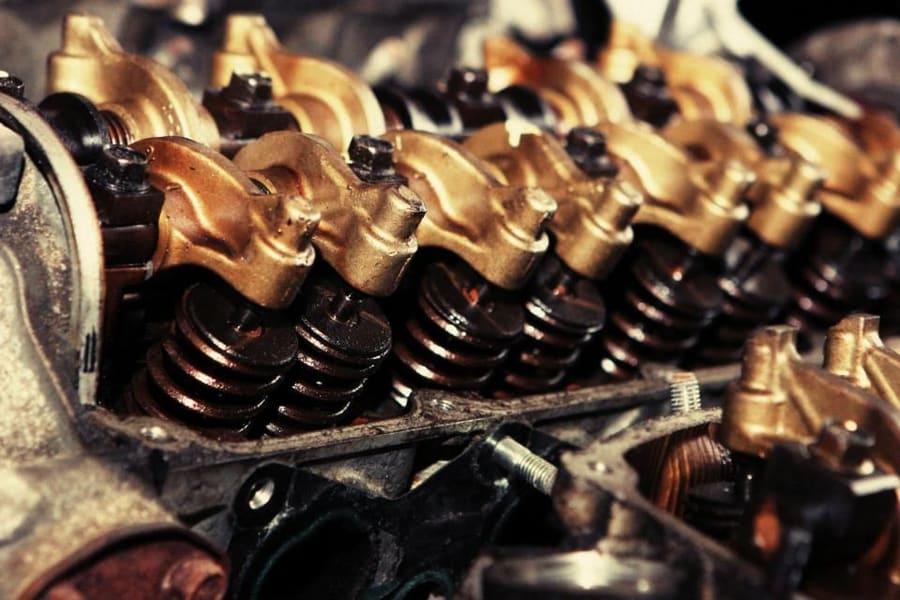
The engine stops instantly. On an interference engine, the pistons rise into open valves in that same instant and bend them. The timing belt is what keeps the crankshaft and camshafts synchronized so valves and pistons pass through the same space at different moments; lose the belt, lose the choreography.
The bill reflects it. A cylinder head rebuild after a snapped belt runs about $2,500 on the friendly end ($900 in valves, gaskets, and machine work plus $1,600 of labor), and a used replacement engine with swap labor pushes the range to $6,500. Some estimates for a full engine replacement reach $13,000, which on an older car is more than the car is worth. This is why the $850 to $1,400 kit job is cheap insurance.
Non-interference engines are more forgiving: the belt breaks, the engine simply stops, and you need a tow and a new belt. But most belt-equipped engines on the road are interference designs, so assume yours is until you confirm otherwise.
Why Do Mechanics Replace the Water Pump at the Same Time?
Because on most belt-driven engines the belt drives the pump, and the labor to reach one is the labor to reach both. Once the timing covers are off, adding the water pump, tensioner, and idlers costs $200 to $350 in parts and almost no extra labor. Skip the pump and have it fail a year later, and you pay the same $540 to $880 of teardown labor all over again, which is most of what a standalone water pump replacement costs. Worse, a leaking or seized pump can take out the brand-new belt and put you right back in interference-failure territory. This is not a shop padding the ticket; it is the one add-on that is genuinely in your interest, and the same logic covers the tensioner, the idler pulleys, and often the front cam and crank seals.
What to Do, in Order
- Confirm belt or chain. Look up your exact year, engine, and trim. Chain-driven, you're done.
- Find the interval. Owner's manual or manufacturer maintenance schedule: miles and years both.
- Check the service history. Receipts, a sticker under the hood, or dealer records. No proof it was done means it wasn't.
- Find out if your engine is an interference design. This sets your urgency. Overdue on an interference engine is a book-it-this-month item, not a next-year item.
- Get 2 to 3 quotes for the full kit, belt, tensioner, idlers, and water pump, not the belt alone.
- Book it and keep the receipt. A documented timing belt job is real money at resale time.
What Drives the Price
- Engine layout and book hours: 3 to 4 hours on an easy four-cylinder versus 5 to 6 on a transverse V6 or Subaru boxer moves labor from roughly $360 to over $900 at 2026 independent rates.
- Belt only versus full kit: the kit adds $200 to $350 in parts but almost no labor, since everything is already exposed. Skipping it risks paying the full teardown twice.
- Independent versus dealer labor rate: nearly half of US independent shops billed $120 to $159 per hour in 2026, while dealers run $170 to $250. On a 5-hour job that alone is a $250 to $500 swing, and typically $300 to $800 in total savings at an independent.
- Wet-belt design: roughly doubles the labor, 7 to 9 hours versus 3 to 5, because the belt runs inside the sealed engine. Add more if the oil pickup needs cleaning of shed rubber.
- Region and metro market: rural independents bill $80 to $120 per hour while high-cost metros exceed $160, shifting the same kit job by $300 or more.
- Whether the belt already failed: on an interference engine, failure converts a four-figure maintenance job into $2,500 to $6,500 of valve or engine work.
Timing Belt Replacement FAQ
Should I replace the water pump with the timing belt? Yes, almost always. The pump sits behind the same timing covers, so adding it costs $200 to $350 in parts and nearly zero extra labor. If the pump fails a year later on its own, you pay the same $540 to $880 of teardown labor all over again.
What happens if a timing belt breaks while driving? The engine stops instantly. On an interference engine, the pistons hit open valves in that same instant and bend them. Expect $2,500 to $6,500 for head work or a replacement engine, versus $850 to $1,400 for the scheduled kit job.
How do I know if my car has a timing belt or a timing chain? Check the owner's manual maintenance schedule. A listed belt interval at 60,000 to 105,000 miles means a belt. Chains have no scheduled replacement and normally last 100,000 to 250,000 miles with good oil changes.
Why is the Ford EcoBoost wet belt so expensive to replace? The belt runs inside the engine, bathed in oil. Reaching it takes 7 to 9 hours and special tools, and shops usually replace the oil pump belt and clean the oil pickup at the same time because the old belt sheds rubber into the oil. That is how a belt becomes a $1,200 to $2,000 job.
Can I skip the interval if the belt looks fine? No. Belts fail from age and internal cord fatigue, not just visible cracking, and a belt that looks fine at 110,000 miles can still snap. The interval of 60,000 to 105,000 miles or 7 to 10 years is the manufacturer's tested limit.
Why does the dealer quote so much more than an independent shop? Mostly the labor rate: dealers bill $170 to $250 per hour against $120 to $159 at independents in 2026, and dealer parts carry list-price markup. The parts are often identical. Aisin builds Honda's OE timing kit and sells the same kit aftermarket for $187 to $228.
These ranges cover the belt or full kit and installation at independent shops. They do not include sales tax, shop supplies, and disposal fees, which often add 5 to 10 percent; coolant and oil refills when they are not bundled into the quote; camshaft and crankshaft seals found leaking during teardown, usually $50 to $150 in parts with minimal labor while everything is apart; accessory drive belts, which are cheap to add but sometimes quoted separately; wet-belt extras like the oil pump belt and sump removal; engine mount complications on some transverse engines; or diagnosis, towing, and machine work if the belt has already failed.