


You probably need a wheel alignment if your car drifts or pulls to one side on a flat road, your steering wheel sits crooked while you're driving straight, or your tires are wearing down faster on the inner or outer edges than in the middle. In 2026, a full four-wheel alignment runs $95 to $160 at independent shops, and a front or thrust-angle alignment for solid-rear-axle trucks runs $65 to $110.
Small errors get expensive fast. About one third of a degree of toe misalignment drags each tire sideways roughly 68 feet every mile, and in 2026 the four-wheel alignment that fixes it costs $95 to $160 at independent shops. The good news: your car tells you when it's out of alignment, and the signs take about five minutes to check yourself. Here's how to read them, what a fair price looks like, and how to tell alignment problems apart from the balancing issues they're constantly confused with.
Want your number first? The alignment cost calculator prices this job for your exact year, make, and model in about thirty seconds, then come back for what's behind the number.
What Does a Wheel Alignment Cost in 2026?
| Scenario | Typical price installed |
|---|---|
| Front-end or thrust-angle alignment, independent shop | $65 to $110 |
| Full four-wheel alignment, independent shop | $95 to $160 |
| Lifetime or multi-year alignment plan (prepaid) | $180 to $260 |
| Alignment after suspension or steering work | $70 to $200 |
| Lowered or modified car, custom-spec alignment | $150 to $450 |
| Alignment plus ADAS recalibration (many 2018 and newer cars) | $245 to $560 |
An alignment has no parts bill. The whole job is 45 to 60 minutes of rack time, which is why the same service carries such different price tags depending on who sells it. Tire chains run promos at $69 to $99 because alignment is a door-opener that wins them the tire and brake work. Dealers charge $150 to $250 for the same rack time. National-average sites like RepairPal publish $186 to $273 because they price the job at full book labor rates. The honest independent-shop number sits between those extremes at $95 to $160 for four wheels.
What Are the Real Signs You Need an Alignment?
The three reliable signs are a car that pulls to one side on a flat road, a steering wheel that's off-center when you're driving straight, and tire wear concentrated on the edges of the tread. Everything else, like vibration, noise, or vague handling, can be alignment but usually points somewhere else first.
Pulling or drifting. On a straight, level road with light grip on the wheel, the car should track straight. If it consistently wanders left or right, something's off. One caveat: most roads are crowned (tilted slightly toward the shoulder for drainage), so a very gentle drift toward the right is normal in the US. A pull you have to actively correct is not, and our guide to why a car pulls to one side walks through the other causes worth ruling out first.
Off-center steering wheel. The car may drive perfectly straight, but the wheel sits tilted a few degrees while it does. That means the wheels aren't pointing where the steering wheel says they are: a classic toe misalignment, and often the first sign after suspension work or a curb strike.
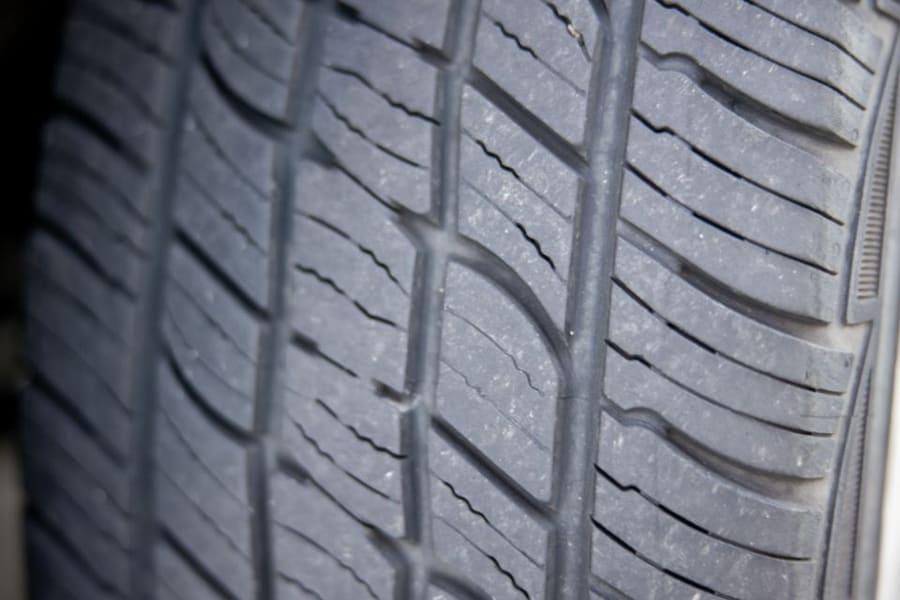
Edge wear on the tires. Run your palm across the tread. If one edge is noticeably more worn than the rest, or the tread feels feathered, smooth in one direction and jagged in the other, the tire is being dragged slightly sideways as it rolls. That's alignment, and it's actively destroying the tire.
Squealing on gentle turns can also signal misalignment, since a scrubbing tire complains. But steering-wheel vibration at highway speed? That's usually the next section's problem.
Is It Alignment or Balancing?
Alignment fixes pulling and uneven tire wear; balancing fixes vibration. They're different services performed on different machines, and confusing them is how people pay for the wrong one.
An alignment adjusts the angles of your wheels relative to the car and each other. In plain words: camber is how much the tire leans in or out at the top, caster is how far back the steering pivot tilts (it's what makes the wheel self-center after a turn), and toe is whether the tires point slightly at each other or away. Toe is the one that gets knocked out most often, and it's the tire killer. The technician puts the car on a rack, measures those angles with sensors, and adjusts suspension components until they're back within the manufacturer's spec.
Balancing corrects uneven weight distribution around the wheel-and-tire assembly itself. Small weights are attached to the rim so the wheel spins without wobbling. An out-of-balance wheel shakes, typically a steering-wheel vibration that shows up in a specific band at highway speed, but it won't pull the car or chew a tire edge. If shaking is your main symptom, start with our guide to a car shaking at highway speed.
Quick rule of thumb: pulls or wears funny, think alignment. Shakes at speed, think balance. Does both, get both checked; they're often bundled anyway when you buy tires.
How Often Should You Get a Wheel Alignment?
There's no dashboard light for alignment, so it runs on events, not sensors. Get one when any of these happen:
- You buy new tires. New tires wear to whatever the current alignment is, and bad toe can chew visible edge wear into fresh rubber within a few thousand miles. Many tire shops will check alignment free with an install, so ask.
- You've had suspension or steering work. Any part that locates a wheel changes toe, so an alignment after struts and shocks, control arms, or tie rods is not optional. Many shops discount it when it rides along on the same invoice as the suspension job.
- You hit something hard. A deep pothole at speed, a curb, a parking block. One good impact can knock things out of spec.
- The signs show up. A pull, an off-center wheel, or edge wear means it's due regardless of when the last one happened.
If your car tracks straight, the wheel is centered, and the tires are wearing evenly, you're not overdue just because a service advisor says so. The exception is lifetime-plan holders, who should come back on a schedule to get their money's worth; Firestone suggests every 6 months or 6,000 miles.
Is a Lifetime Alignment Plan Worth It?
Usually yes, if you actually use it. Firestone's lifetime plan runs about $210 to $260 in 2026, and $20 coupons are common, so call it roughly $230. That equals about two of its $110 single alignments, which means the plan breaks even on the second or third visit. Pep Boys sells a 5-year plan near $180 and a 1-year plan near $115.
The plan wins for anyone keeping the car 3 or more years, driving pothole country, or running through multiple sets of tires. It loses if you sell the car within a year, since the plan doesn't transfer to the next owner.
What Happens to Your Tires If You Skip It?
Bad alignment destroys tires quietly, from the edges inward. A wheel that's toed out even slightly gets dragged sideways a little with every rotation, like sliding a pencil eraser across a desk for thousands of miles. The tread doesn't wear down; it gets scrubbed off. A 2024 Journal of Engineering study measured up to 25 percent tire-life loss from small toe errors, and with a set of tires running $600 to $1,000, a $95 to $160 alignment is cheap insurance.
The damage compounds. Uneven tread means less rubber where you need it in the rain, which raises hydroplaning risk before the tire is anywhere near its wear bars. The constant scrubbing adds rolling resistance, which shows up as a small but real hit to fuel economy. And the misalignment feeds extra stress into suspension components that were never meant to carry a fighting tire.
What to Do If You Suspect Your Alignment Is Off
- Check tire pressure first. A low tire on one side mimics an alignment pull almost perfectly, and it's free to rule out.
- Do the flat-road test. On a straight, level, empty stretch, relax your grip and see if the car tracks straight and the wheel sits centered.
- Feel the tread. Palm across each tire; look for edge wear or feathering, and compare left side to right.
- Get a measurement, not an opinion. Ask for the printout showing your actual angles against factory spec, before and after, if you have the work done.
- Fix worn parts before aligning. If the shop finds a loose tie rod end or bad ball joint on the rack, they can't align the car to spec until it's replaced. Expect a call quoting the part plus another $80 to $200 in labor, and don't read it as an upsell; aligning around loose parts wastes the alignment.
- Recheck if the wheel drifts off-center again. Single alignments usually carry a 30-day to 12-month warranty depending on the shop, so if the wheel is still crooked a week later, the recheck should be free.
What Drives the Price
- Two-wheel vs four-wheel service: front or thrust-angle runs $65 to $110 and four-wheel runs $95 to $160 at independents. Most modern cars need four-wheel, so a front-only quote on a newer sedan deserves a second question.
- Who does it: the same rack time prices at $69 to $99 on chain promotions, $95 to $160 at independent shops, and $150 to $250 at dealers. The dealer premium buys factory specs and OEM software, not a better alignment on a stock car.
- ADAS sensors on 2018 and newer cars: camera or radar recalibration adds $150 to $400 at independents and glass shops, $400 to $1,200 at dealers, and can double or triple the invoice.
- Modifications and ride height: lowered, lifted, or camber-kit cars pay $150 to $300 for the custom-spec setup plus $50 to $150 in adjustment hardware when needed, and some chain stores refuse modified cars outright.
- Condition of the parts underneath: seized adjusters, worn tie rods, or bad ball joints stop the job. Camber bolts or shims add $20 to $60 in parts; a worn steering part adds a whole separate repair before the alignment can finish.
- Regional labor rates: independent shop labor spans roughly $85 to $197 per hour by state in 2026, with a national average around $132, so the same alignment costs less in North Carolina than in California.
Wheel Alignment FAQ
How much does a wheel alignment cost in 2026? At independent shops, expect $65 to $110 for a front or thrust-angle alignment and $95 to $160 for a full four-wheel alignment. Chain stores run promos at $69 to $99, dealers charge $150 to $250, and cars needing ADAS recalibration can hit $245 to $560 total.
Do I need a 4-wheel alignment or just the front? If your car has independent rear suspension, which covers most vehicles built after about 2000, you need the four-wheel service because the rear wheels steer the car too. Front-only or thrust-angle alignment fits solid-rear-axle pickups and older vehicles.
How do I know if my car needs an alignment? The car pulls to one side on a flat road, the steering wheel sits off-center when driving straight, or your tires wear faster on the inner or outer edge. Also get it checked after hitting a big pothole or curb, and always after any suspension or steering repair.
Is a lifetime alignment plan worth it? Usually yes if you keep the car 3 or more years. Firestone's lifetime plan costs about $230 in 2026 against roughly $110 per single visit, so it pays for itself on the second or third alignment. It's not worth it if you sell the car soon, since plans don't transfer to the next owner.
Do I need an alignment after getting new tires? It's not automatic, but it's the smartest time to do it. New tires wear to whatever the current alignment is, and bad toe can chew visible edge wear into fresh rubber within a few thousand miles. Many tire shops will check alignment free with an install.
Why does an alignment cost more on newer cars? Many 2018 and newer cars carry lane-keep cameras and front radar that reference the direction the car actually travels. When an alignment changes that thrust line, those sensors can need recalibration, which adds $150 to $400 at independent shops on top of the alignment itself.
These ranges cover the alignment service itself at independent shops. They don't include worn parts discovered on the rack: tie rod ends, ball joints, or control arms typically add $80 to $300 each installed, and the alignment can't be finished to spec until they're replaced. They also leave out ADAS camera or radar recalibration unless the quote names it, camber bolts or kits for vehicles out of factory adjustment range at $20 to $150 in parts plus install time, and tire rotation and balancing, which are separate menu items even though they often ride on the same visit. Sales tax, shop supply fees, and rechecks outside the warranty window are extra too.