



A radiator replacement on most cars runs $420 to $920 at an independent shop in 2026, parts, coolant, and labor included. Full-size trucks are their own category at $950 to $1,850, and luxury or European models span $880 to $1,950. The spread is wide for a real reason: the part is only half the bill, and the labor swings from 2 hours on a Corolla to 5.5 on a Silverado.
The radiator is also one of the few parts that gives you plenty of warning before it strands you. A small stain on the driveway, a temperature needle that creeps a little higher in traffic, a sweet smell after a highway run. Catching it at that stage is a planned repair. Ignoring it until the engine overheats is how a $500 to $900 radiator job turns into a $2,000 to $4,500 engine repair. Here is what a fair 2026 price looks like and how to tell where on that timeline you are.
Want your number first? The radiator cost calculator prices this job for your exact year, make, and model in about thirty seconds, then come back for what's behind the number.
What Does a Radiator Replacement Cost in 2026?
| Scenario | Typical price installed |
|---|---|
| Economy car (Honda Civic, Toyota Corolla, Hyundai Elantra) | $420 to $780 |
| Midsize sedan or crossover (Camry, Accord, Altima, RAV4) | $530 to $920 |
| Full-size truck (F-150, Silverado 1500, Ram 1500) | $950 to $1,850 |
| Luxury or European (BMW 3/5 Series, Mercedes C-Class, Audi A4) | $880 to $1,950 |
| Plastic end-tank crack, caught before overheating | $450 to $1,350 |
The math behind the economy-car number: an aftermarket radiator plus coolant and clamps runs $150 to $330 (AutoZone lists Civic radiators at $114 to $320), and the job books 2.0 to 3.0 hours at $135 to $150 per hour, so $270 to $450 in labor. Add it up and you land at $420 to $780. National-average sites sit far higher: RepairPal shows $832 to $1,104 for those same cars and a $1,361 to $1,541 national average, because its estimates assume roughly $1,000 in near-OEM parts. An independent shop installing a quality aftermarket unit runs $400 to $700 below that. Your exact vehicle moves the number more than anything else, so it is worth looking up radiator cost by exact vehicle before you read any quote.
The dealer gap is just as consistent. Per MechanicNow's 2026 cooling-system cost report benchmarking 45 vehicle models, independent shops charged an average of 38% less than dealerships for radiator replacement, with economy sedans at $480-780 independent versus $820-1,200 at the dealer. Dealers bill $170 to $250 per hour against the independent range of $120 to $159, and they install OEM radiators at 2 to 3x the aftermarket part price. Same job, two very different invoices.
Why Radiators Fail at 8 to 10 Years
Almost every modern radiator is an aluminum core with nylon-plastic end tanks crimped on. Hot coolant cycles slowly embrittle that plastic, and the tanks typically crack at 8 to 10 years, which is why radiator failure tracks age more than mileage. A garage-kept, low-mileage car is on the same clock as a highway commuter.
Once a tank cracks or a crimp seal starts weeping, it is a replace-not-repair part. Epoxy on a plastic tank is a limp-home fix at best, and stop-leak products work by depositing material inside the cooling passages, which is the opposite of what a heat exchanger needs. That is why shops quote a whole new radiator rather than a tank repair, and why that recommendation is almost always the right one.
The water pump lives in the same loop and wears on the same aging coolant, so the two failures often arrive close together. Our water pump replacement cost guide covers that side of the system.
What Are the Warning Signs of a Failing Radiator?
The good news is that radiators rarely fail without notice. Watch for these:
- Coolant puddles or drips under the front of the car. Coolant is usually orange, pink, green, or blue, and it feels slippery. A drip directly under the radiator or a stain on the plastic underbody shield is the clearest sign.
- A sweet, syrupy smell after driving, sometimes with a faint wisp of steam from the front of the hood. That is coolant hitting hot surfaces.
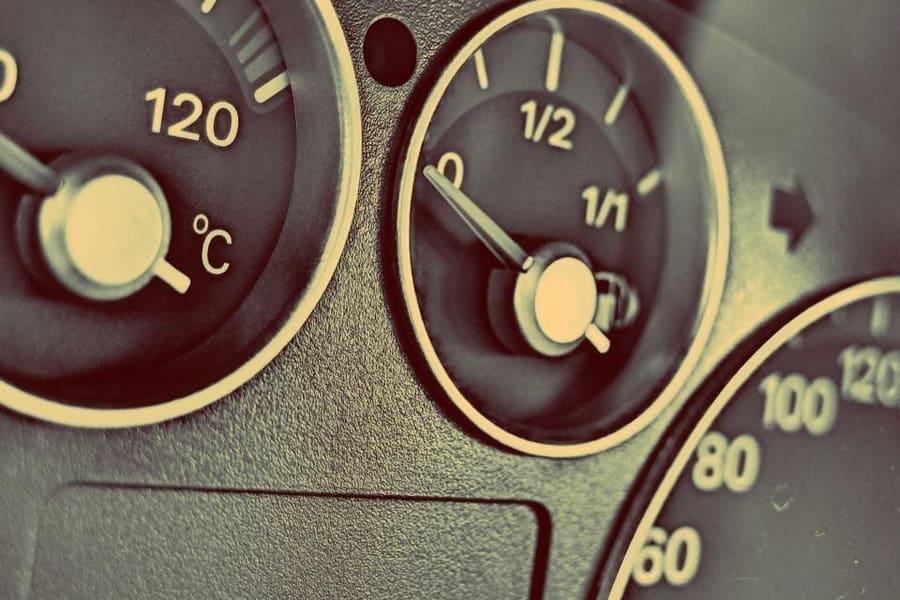
- A temperature gauge that climbs above its usual position, especially in stop-and-go traffic or while towing, then settles back on the highway. A partially blocked radiator or a low coolant level shows up first at low speed, when there is less airflow.
- The coolant reservoir keeps dropping and you find yourself topping it off every few weeks. Coolant is not consumed in a healthy system, so a falling level always means it is going somewhere.
- White, crusty residue on the radiator seams, hoses, or plastic tanks. That is dried coolant, and it marks a slow weep even when nothing is dripping at the moment.
- Rust-colored or muddy coolant in the reservoir. Contaminated coolant means the system has been neglected and the internal passages may be silting up.
- Heat that blows lukewarm at idle. Your heater core runs off the same coolant loop, so cooling system problems often show up as a comfort complaint first.
Any one of these is worth a look. The temperature gauge climbing is the one that means stop driving and get it checked now, not next month. If your car is already running hot, our guide on what to do when your car overheats walks through the first sixty seconds.
Why Does a Truck Radiator Cost Double?
Trucks cost roughly double compacts for a real mechanical reason, not a markup. The core is physically bigger, automatics route transmission cooler lines through it, and the system holds 4 to 5 gallons of coolant instead of about 1.5. Book time runs 3.5 to 6.0 hours versus 2 to 3 on a sedan: a 2020 Silverado books 5.5 hours and a 2016 F-150 5.0L books 5.4. At $140 to $160 per hour, the labor alone is $530 to $970 before the $420 to $880 radiator goes in. Most half-tons with tow packages land at $1,100 and up, and diesels and HD trucks hit the top of the range.
The Line Items That Are Not Padding
Shops commonly quote new upper and lower hoses, a thermostat, and a radiator cap with the radiator, adding about $100 to $250. It is not padding: 10-year-old hoses clamp poorly onto new plastic radiator necks, and the coolant is already drained, so the second labor charge you would pay later disappears into this job.
The refill is the other quiet skill on the invoice. Modern engines need a vacuum fill or a specific air-bleed procedure, because a trapped air pocket can overheat and warp the engine that just got a new radiator. That refill-and-bleed step is typically $100 to $150 of the bill, and a quote that includes it is a quote from a shop doing the job right.
One more thing worth knowing before the front end comes apart: the A/C condenser bolts directly in front of the radiator and often shares brackets, so it gets unbolted and swung aside during the job. On a healthy car that costs nothing extra. If a corroded condenser breaks, or the sealed A/C lines have to be opened, refrigerant recovery and recharge adds $150 to $300, and a condenser replacement averages $833 to $978 on its own. A good shop flags that risk on your specific vehicle before starting.
What Drives the Price
- Vehicle class and radiator size: the single biggest swing. Compact-car radiators are $114 to $320 retail, while full-size truck cores with built-in transmission coolers run $300 to $900. Class alone moves the total from about $420 to $1,850.
- OEM versus aftermarket: OEM units cost 2 to 4x aftermarket for the same vehicle, $450 to $900 versus $120 to $350. This one choice is most of the gap between national-average sites and what independents actually charge.
- Labor hours by design: 2 to 3 hours on most sedans, 3.5 to 6.0 on trucks and turbo engines with intercooler plumbing, up to 6 or more on some Europeans. At $140 per hour, each extra hour is $140 straight onto the bill.
- Coolant capacity and spec: about 1.5 gallons on a compact versus 4 to 5 on a truck, at $25 to $50 per gallon for OEM-spec coolant, plus the $100 to $150 vacuum-fill or bleed procedure.
- Collateral parts bundled in: hoses, thermostat, and cap add $100 to $250. Damaged transmission cooler fittings on trucks, or opening the A/C system, adds $150 to $700 more.
- Region and shop labor rate: state averages range from about $120 to $159 per hour in 2026, so the identical job quotes 20 to 30 percent apart between low-cost and coastal metro markets.
Radiator Replacement FAQ
How much does it cost to replace a radiator? At an independent shop in 2026, most cars run $420 to $920 including parts, coolant, and labor. Full-size trucks run $950 to $1,850 and luxury or European models $880 to $1,950. Dealers typically charge 35 to 40 percent more for the same job because of OEM parts and higher labor rates.
Can I just repair a cracked radiator instead of replacing it? Usually no. Modern radiators have plastic end tanks crimped onto an aluminum core, and once a tank cracks or a crimp seal fails, epoxy or stop-leak is only a limp-home fix. Shops replace the whole radiator because a patched plastic tank fails again under pressure.
How long does a radiator replacement take? About 2 to 3 hours on most sedans and 3.5 to 6 hours on full-size trucks and turbocharged vehicles. A 2020 Silverado 1500 books 5.5 hours and a 2016 F-150 5.0L books 5.4, which is a big part of why truck quotes run higher. Plan on the car being at the shop most of a day.
Can I drive with a leaking radiator? Only far enough to get to a shop, topping off coolant as needed. Running low on coolant overheats the engine, and a warped head or blown head gasket turns a $500 to $900 radiator job into a $2,000 to $4,500 engine repair. A leak caught early is the cheap version of this failure.
Does a radiator replacement include new coolant? Yes, any proper quote includes draining, fresh OEM-spec coolant at $25 to $50 per gallon (1.5 to 5 gallons depending on vehicle), and a vacuum fill or air-bleed procedure. If a quote does not mention coolant and bleeding, ask, because a trapped air pocket can overheat a fresh install.
These ranges cover the radiator, coolant, and installation at independent shops. They do not include overheating collateral damage like a head gasket or warped cylinder head ($2,000 to $4,500 and up, quoted as engine repair), A/C condenser replacement if the old one breaks during removal, transmission cooler line or fitting replacement on trucks, cooling fan or shroud work, or dealer pricing, which typically runs 35 to 40 percent higher for the same job. Taxes, shop supply fees, and any separate diagnostic charge are also on top.